Practical Sales Training™ > How To Convert > Menu Pricing
Menu Pricing
Most buyers hate asking for a price. It feels awkward. So when there is no price in sight, many of them just walk away rather than enquire. Menu Pricing removes that barrier before it even forms.
A simple price menu tells buyers exactly what they get and what it costs. Because there are no surprises, the decision feels safer and easier. That means fewer lost sales to uncertainty and more buyers who are ready to commit.
Menu Pricing is also one of the most practical ways to make yourself easier to deal with. It puts the buyer in control, which is exactly where they want to be.
What Is Menu Pricing?
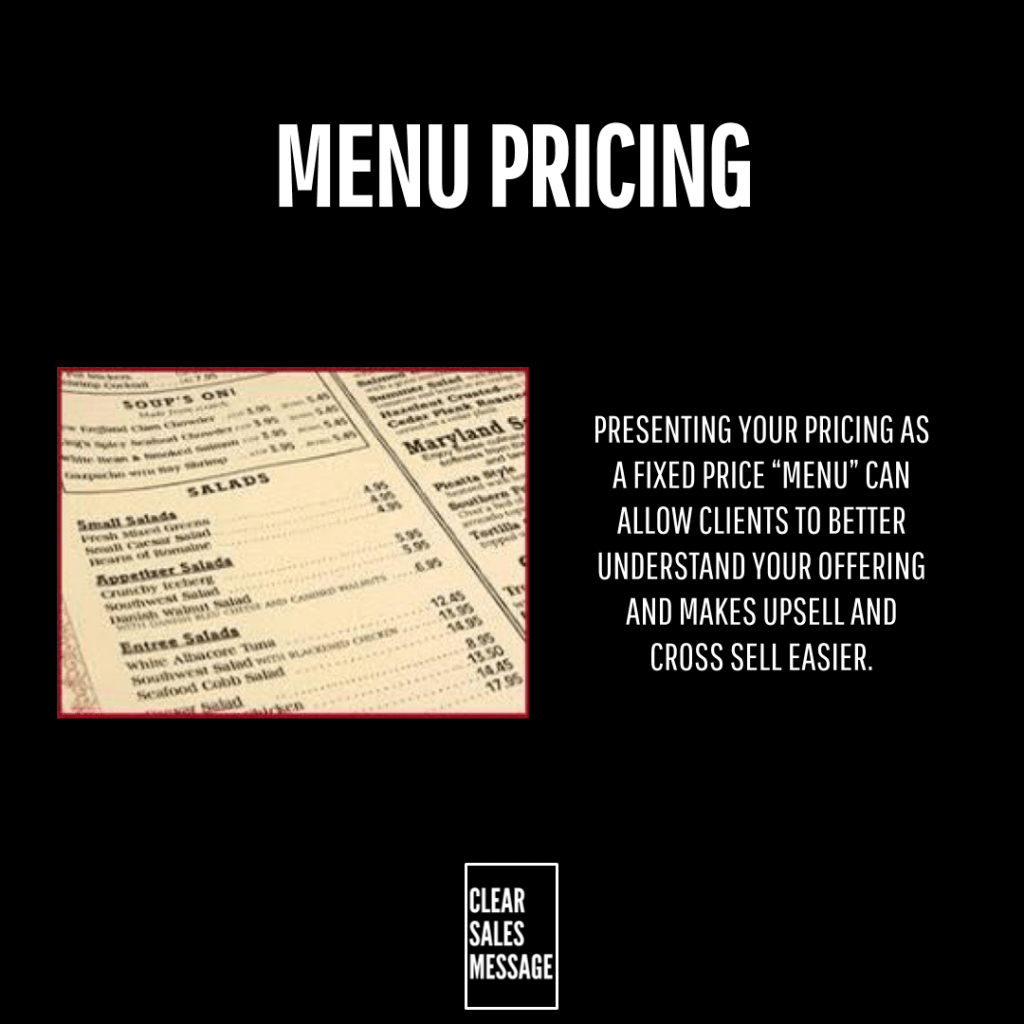
Menu Pricing means presenting your products or services as a fixed, clear list with prices attached. Like a restaurant menu, it shows the buyer what is on offer and what each thing costs.
It can cover your full range or just your most popular options. Either way, the goal is the same: give buyers the information they need without making them ask for it. Because the easier you make the decision, the more likely they are to buy.
Why Does Menu Pricing Work?
It works because buyers are uncomfortable with the unknown. When a price is hidden, the brain fills the gap with fear. That fear creates hesitation, and hesitation kills sales.
A clear price list removes those unknowns and replaces them with certainty. Certainty feels safe. So buyers are far more likely to move forward when they can see exactly what they are signing up for.
Menu Pricing also follows the path of least resistance. It lets buyers self-select the option that suits them without needing a sales call. In fact, it can even highlight your cheapest entry point to get buyers in the door, then let the menu do the upselling for you.
How Can You Use Menu Pricing In Sales?
Put It Online
The simplest place to start is your website. A clear pricing page means buyers can check what you charge before they ever speak to you. That filters out poor-fit buyers and warms up the good ones. So by the time they make contact, they are already halfway to yes.
Include It With Every Sale
A price menu delivered alongside your product or service is a quiet upsell tool. When a client has just bought from you and the experience has been good, they are in the best possible mood to buy more. So a simple menu tucked in with the delivery does the work without any pressure.
Use It to Anchor the Conversation
When you share a menu early in a sales conversation, it anchors the buyer to your full range. They can see what most people buy and what the options above and below that look like. As a result, the conversation moves faster because the buyer already has context.
When Menu Pricing Works Best
Menu Pricing works best when your offer is repeatable and consistent. If you do the same type of work at similar price points, a menu is a natural fit. It also works well when buyers are comparing you to rivals, because a clear price gives them something solid to evaluate.
It is also powerful when you have a range of options at different levels. Because buyers can see the full picture, they often choose a higher tier than they would have picked if you had only quoted one price.
When Menu Pricing Becomes Dangerous
The danger comes when your work is highly bespoke. If every job is different, a fixed menu can under-price complex work or make simple jobs look expensive by comparison. So think carefully before you publish a price for something that varies a lot.
There is also a risk that buyers focus only on price rather than value. If your menu shows numbers without context, some buyers will go straight to the cheapest option. However, you can manage this by framing each tier clearly and showing what they get at every level.
Common Menu Pricing Mistakes
Too Many Options
A menu with ten options causes confusion, not clarity. When buyers face too many choices, they often make no choice at all. So keep your menu tight. Three to five options is usually enough to cover the range without overwhelming the buyer.
Prices Without Context
A number on its own means nothing. Buyers need to know what they get for the price. So always describe the outcome or deliverable next to the figure. Because when the value is clear, the price feels justified.
Never Updating It
A menu with old prices or outdated options creates confusion and erodes trust. If your costs change, update the menu straight away. An out-of-date price list is worse than no price list at all.
Menu Pricing – An Example
A small photography studio creates a simple menu for its services:
- Portrait Session – £150
- Family Shoot – £250
- Wedding Package – £1,500
- Photo Editing (per image) – £20
By showing these prices clearly, clients can see all the options without asking for a quote. A family who came in thinking about a £150 portrait session can now see the £250 family shoot, which offers more time and more edited photos. Because the upgrade is visible, many of them take it.
See Also: