
Practical Sales Training™ > How To Connect With Your Buyer > Action Phrase

Action Phrase
Most sales messages tell buyers what something is. The best ones, however, tell buyers what to do. And the very best ones do that in a way so clean and catchy that the buyer repeats it to someone else without even thinking.
That is what an action phrase does. So instead of a long description, the buyer gets a short instruction that feels completely natural. It takes the behaviour or mindset you want to encourage and compresses it into something sharp and easy to say.
The difference between a forgettable message and one people actually use often comes down to rhythm. Because when words flow well together and feel good to say, they travel. And phrases that travel do your selling for you, long after the conversation ends.
What Is An Action Phrase?
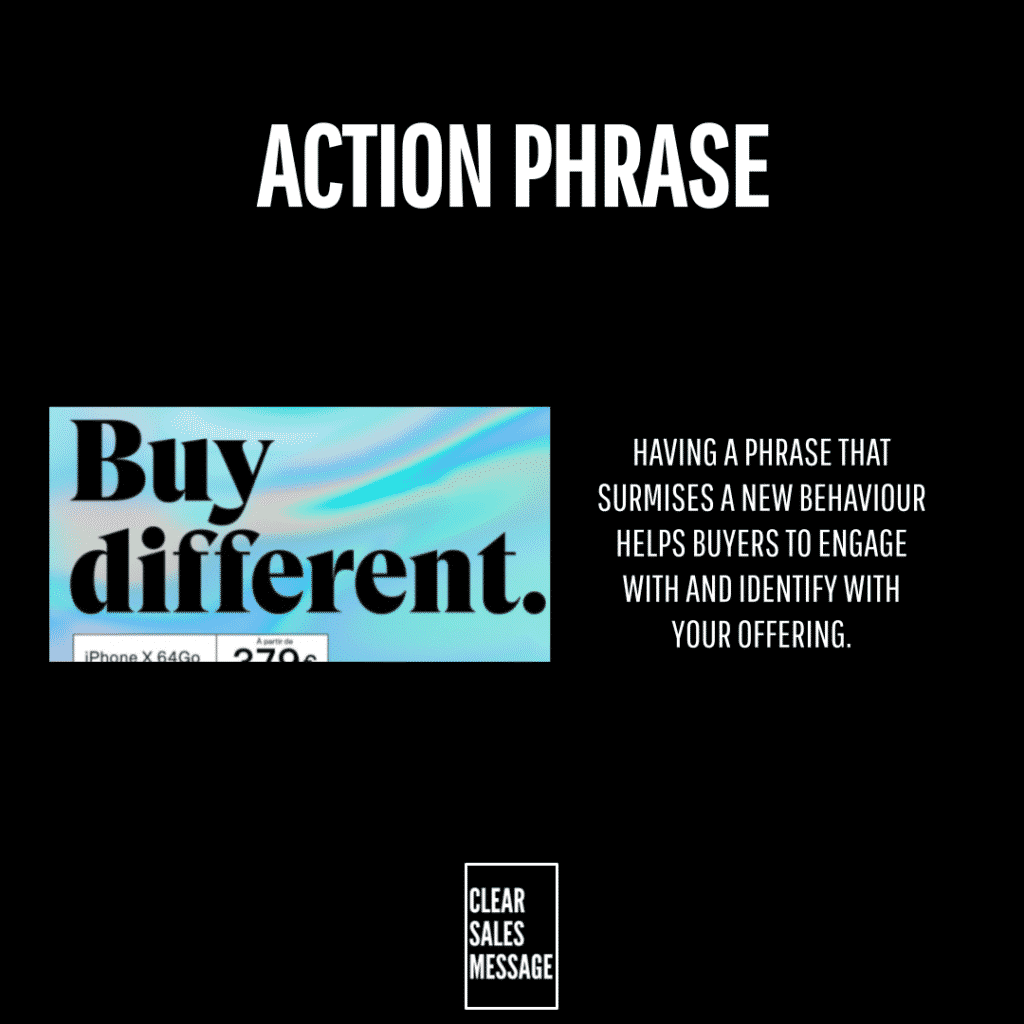
An action phrase is an action-focused phrase that empowers people to do something specific. It usually pairs a verb with a word that shapes how that action feels. For example: buy differently, eat simply, drive respectfully. Each one tells you what to do and how to do it in just two words.
This makes action phrases different from a call to action (CTA). A CTA tells someone how to buy from you right now. An action phrase, however, is more about mindset. It shapes how your buyer thinks about what they do, and as a result positions your brand as the enabler of that behaviour.
Why Do Action Phrases Work?
Anything mellifluous – smooth, musical, easy on the ear – naturally carries weight and sticks in the mind. When something feels good to say or hear, people use it. And because people use it, it spreads.
That is the real power of an action phrase. It is not just memorable to the person who first hears it. It is also repeatable. So when a buyer passes it on to a colleague, a friend, or a decision maker, your message travels with it at no extra effort on your part.
Subway’s “Eat Fresh” is a perfect example. Two words that tell you exactly what to do and how it will feel. Simple, clear, and impossible to forget. Because the best action phrases do not just describe a product. Instead, they describe a way of living that the buyer wants to be part of. And that is a far more powerful thing to sell.
How Can You Use Action Phrases In Sales?
Start by thinking about the action you want your buyer to take, or the action your offer makes possible. Then ask whether you can reduce that to a short, punchy, two or three word phrase that captures the spirit of it. In most cases, the simpler the better.
The formula is usually straightforward: verb plus adverb or adjective. Buy different. Book responsibly. Dress comfortably. Each one leads with action and follows with feeling. Together, therefore, they tell the buyer not just what to do but why it matters.
Lead with a verb
Action phrases work because they start with movement. A verb puts the buyer in the driving seat and, as a result, frames your brand as the thing that makes that action possible. So resist the urge to start with an adjective or a description. Instead, start with what the buyer does. Buy, eat, drive, book, dress – these words create energy that descriptive words simply cannot. The result is a phrase that feels active rather than flat.
Test it out loud
The best action phrases feel good to say. So before you settle on one, say it out loud a few times. Does it flow naturally? Would you use it in normal conversation? If it feels clunky or forced when you speak it, it will feel the same way to your buyer. Rhythm matters as much as meaning here, because a phrase that jars will never spread. And a phrase that never spreads never sells.
Use it consistently across your communications
An action phrase only works if people hear it enough times to remember it. So once you have one that feels right, use it everywhere – in your pitch, your proposals, your social media, your email sign-offs. Repetition is what turns a good phrase into something buyers associate with your brand. Similarly, the more consistently you use it, the faster that association forms. And the faster it forms, the less hard you have to work to be remembered.
When Action Phrases Work Best
They work best when you want to build a strong, consistent brand identity around a behaviour or value. They are also highly effective when your category has lots of competition, because a distinctive action phrase gives buyers something specific to connect to your name. And the more buyers repeat it, the stronger that association becomes over time. In fact, in crowded markets, a great action phrase can do more for recognition than a much bigger marketing budget.
When Action Phrases Become Dangerous
They fall flat when they are too generic to mean anything. “Do better” or “think smarter” sound like action phrases but, in reality, belong to no one. If your phrase could sit on a competitor’s website without anyone noticing, it is not doing the job. The best action phrases feel specific to what you do and who you are. Vague ones, however, fade quickly and leave no impression at all. So specificity is not just helpful here. It is essential.
Common Action Phrase Mistakes
Most people either overthink the words or pick something that sounds good but means nothing. Both are easy traps to fall into. Here are two mistakes worth avoiding.
Confusing it with a tagline
A tagline describes your brand. An action phrase, however, directs your buyer. These are different things and they work differently. “The future of finance” is a tagline. “Spend smarter” is an action phrase. Both have value, but if you want something buyers repeat and act on, the action phrase is the stronger tool. So make sure you know which one you are building before you start, because mixing the two up leads to something that does neither job well.
Making it too long
Two or three words is the sweet spot. Beyond that, the phrase loses its punch and becomes harder to remember. If you find yourself writing five or six words, look for what you can cut. The constraint is the point, because short phrases stick in a way that long ones simply do not. Also, long phrases get trimmed or forgotten by the time the buyer passes them on. So cutting words is not weakening the phrase. It is strengthening it.
Action Phrase – An Example
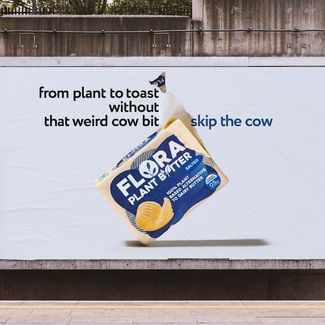
“Skip the cow” is the phrase used by a plant-based butter brand to position their product against dairy. It is catchy, bold, and instantly clear about what the buyer should do and why. You do not need to know anything else about the brand for the phrase to land. That is exactly what a strong action phrase does – it works on its own, without context, because the meaning is built into the words. As a result, the brand travels further than any ad could take it alone.
Here are some simple examples of how the formula works in practice:
| Buy | Different |
| Book | Responsibly |
| Dress | Comfortably |
| Eat | Simply |
| Drive | Respectfully |
See also
- 150+ ways to connect with your buyer
- The Tagline Effect
- 100+ ways to be more memorable
- Call To Action

