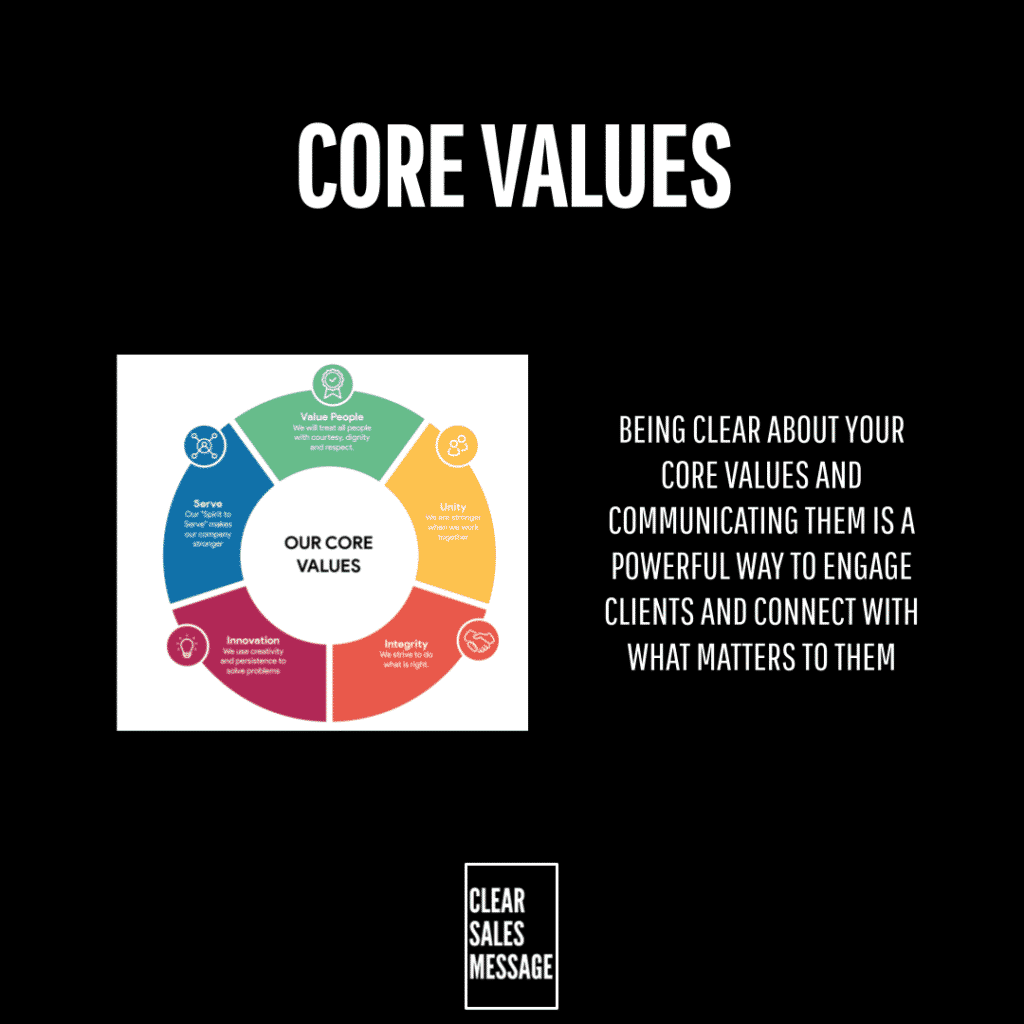


Practical Sales Training™ > How to connect with your buyer > Core Values
Core Values
People buy from people they like and trust. But trust takes time. And in a crowded market, you often don’t get much of it before a buyer moves on.
Core Values give you a shortcut. When a buyer reads your values and thinks “that’s exactly how I think,” the connection happens fast. Not because you sold them something. Because they recognised themselves in what you stand for.
That recognition is powerful. It brings in the right buyers, filters out the wrong ones, and sets the tone for the entire relationship before the first conversation even starts.
What Are Core Values?
Core Values are the principles and beliefs that guide how you work. They’re not a mission statement or a list of services. Instead, they’re a declaration of what matters to you and how that shapes the way you operate.
For example, a business might have Core Values like “honesty over hype,” “people before process,” or “do the right thing, even when it’s hard.” Each one tells a buyer something real about what it’s like to work with you.
Think of Core Values as a named process of working. They show buyers not just what you do, but how you do it. And that “how” is often what tips a buyer from considering you to choosing you.
Why Do Core Values Work?
Buyers don’t just buy products and services. They buy relationships. And the foundation of any good relationship is shared values. So when a buyer sees their own beliefs reflected in your Core Values, they feel an instant pull toward you.
There’s also a filtering effect. Likeminded people are drawn to businesses that share their outlook. But buyers who don’t share your values will self-select out. As a result, you spend less time on poor-fit prospects and more time with buyers who are genuinely aligned.
Core Values also reduce risk in the buyer’s mind. A clear set of values tells them what to expect from you before the work begins. That clarity builds confidence. And confidence makes buying decisions easier to make.
How Can You Use Core Values In Sales?
If you don’t have Core Values yet, start by looking inward. What do you genuinely believe about the way good work gets done? What would you never compromise on, even under pressure? The answers to those questions are the raw material for your values.
Find Your Values
Take inspiration from companies like Apple or Nike, who communicate their values clearly and consistently. You can also browse a list of core values and mark the ones that feel genuinely true for you. Don’t pick what sounds impressive. Pick what’s real. Buyers can tell the difference.
Put Them Where Buyers Will See Them
Core Values only work if they’re visible. Add them to your website, your proposals, your email signature, and your social profiles. The more touchpoints a buyer sees them at, the more consistent and credible your values feel. Repetition builds belief.
Bring Them Into Conversations
Don’t just display your Core Values. Reference them naturally when you talk to buyers. “One of the things we really believe in is transparency, so I want to be upfront about this from the start.” That kind of language shows the values are lived, not just listed. And buyers notice the difference.
Use Them to Qualify Buyers
Core Values work both ways. They attract the right buyers and signal to the wrong ones that you may not be the right fit. That’s not a bad thing. A buyer who doesn’t share your values will likely be a difficult client. So use your values as a filter, not just a magnet. The work that follows will be better for it.
When Core Values Work Best
Core Values work best when they’re specific and genuine. Vague values like “excellence” or “innovation” don’t connect because every business claims them. But a value like “we always tell you what you need to hear, not what you want to hear” is specific enough to mean something and attract the right buyer.
They also work best in markets where relationships matter. In industries where buyers make long-term decisions or work closely with a supplier, shared values become a major deciding factor. Because the buyer isn’t just choosing a service. They’re choosing a working relationship.
Similarly, Core Values are most powerful for smaller businesses competing against larger ones. A big firm might win on price or scale. But a smaller business with clear, human values can win on fit. And fit often matters more than size.
When Core Values Become Dangerous
The biggest risk is values that aren’t lived. If you claim to value honesty but regularly overpromise, buyers will notice. The gap between stated values and actual behaviour is one of the fastest ways to destroy trust.
Also watch out for values that are too broad or too safe. A list of values that reads like every other business’s list adds no signal. However, a short set of honest, specific values that reflect how you actually work carries real weight.
And don’t treat Core Values as a one-off branding exercise. They need to show up in every conversation, every proposal, and every decision you make. Otherwise they’re just words on a page.
Common Core Values Mistakes
Picking Values That Sound Good Rather Than Ring True
It’s tempting to choose values that look impressive. But buyers see through values that feel like marketing. Instead, choose the ones you’d stand by even when they cost you something. Those are the values worth sharing.
Hiding Them Away
Some businesses tuck their Core Values into an About page nobody reads. For values to do their job, they need to be visible at every stage of the buyer journey. So put them front and centre, not buried at the bottom of a page.
Having Too Many
A list of twelve Core Values is a list of none. Buyers can’t hold that many in their head. Three to five strong, specific values land far harder than a long list of generic ones. Cut until every value on your list is one you’d genuinely fight for.
Core Values – An Example
A boutique branding agency competes with several larger, cheaper firms. To stand out, they share three Core Values clearly on their website:
- Creativity with purpose.
- Honesty over hype.
- Partnership over transactions.
When a potential client reads these, they feel aligned before a single conversation has taken place. In the first consultation, the client says: “Your honesty value is why I reached out. I’ve worked with agencies who overpromise, and I want to avoid that.”
The agency didn’t win the client on price or portfolio. They won them on values. Because the buyer saw their own beliefs reflected back, the trust was already there before the work began. That’s what Core Values, communicated clearly, can do.
See Also
- The Promise Effect
- The Workforce Effect
- 150+ ways to connect with your buyer
- 100+ ways to be more memorable