
Practical Sales Training™ > How To Lose The Sale > Pitch Slap

Pitch Slap
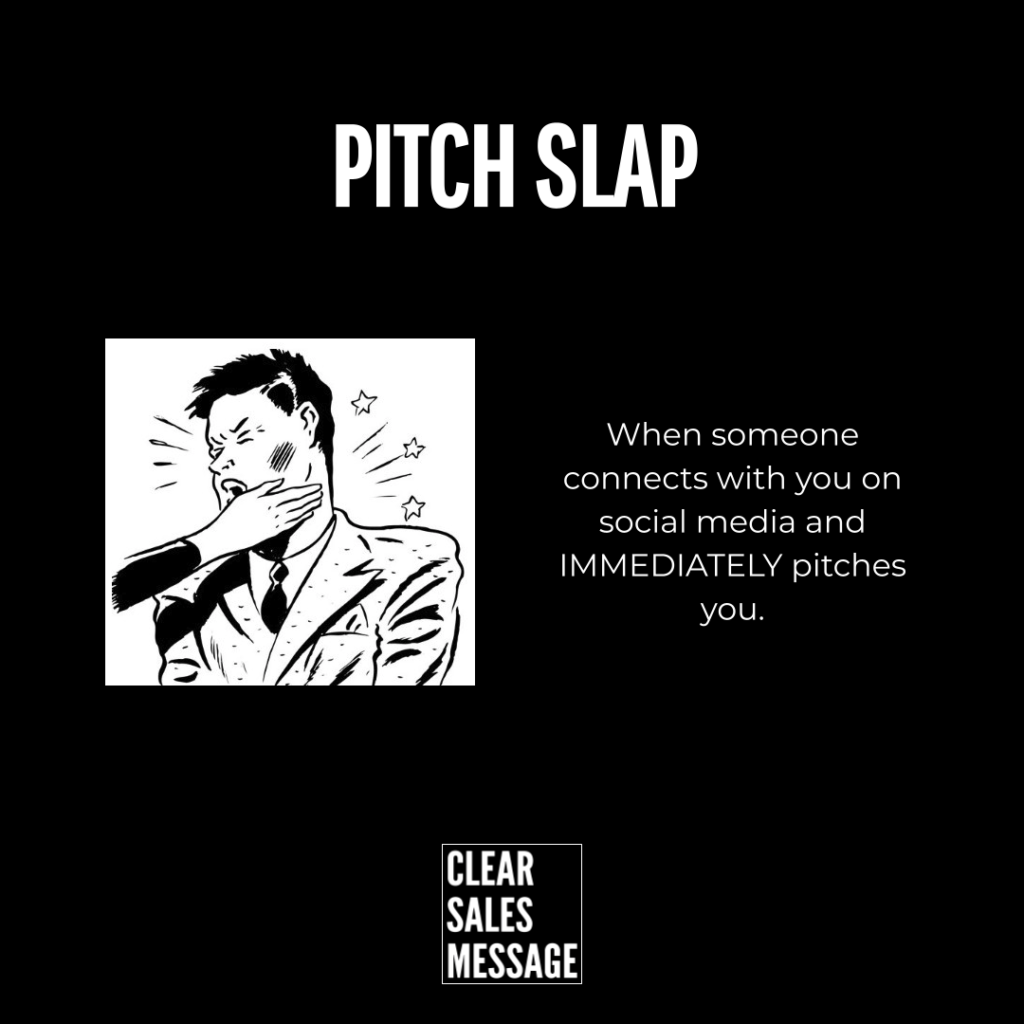
You know the one. Someone sends you a connection request on LinkedIn. They say they love meeting like-minded people. You accept. Thirty seconds later, a pitch lands in your inbox. Product. Price. Call to action. No conversation, no warmth, no interest in you at all.
That is a Pitch Slap. It is one of the fastest ways to destroy trust with a potential buyer. But the problem is, many people doing it do not even realise it is a problem. They think volume and speed will get them results. In fact, all they get is ignored, blocked, or muted.
Because buyers need to feel heard before they feel sold to, the Pitch Slap skips the most important step. It jumps straight to the ask before earning the right to ask. So the buyer switches off, and the opportunity is gone.
What Is a Pitch Slap?
A Pitch Slap is an unsolicited sales pitch delivered the moment someone connects with you, often on social media or by email. There is no warm-up, no question, no interest shown. Just a pitch, straight to the face.
The name says it all. It feels like a slap because it is so jarring. One moment you think you are making a new connection. The next, you are being sold at. The contrast between the friendly opener and the hard pitch that follows is what makes it so off-putting.
It is also linked to connecting under false pretences. The initial message is designed to seem friendly and genuine. But it is just a way to get through the door. Once the connection is made, the mask drops and the pitch begins. Buyers notice this. It damages trust before any real relationship has a chance to form.
Why Does a Pitch Slap Lose the Sale?
It loses the sale because it sends completely the wrong signal. When you pitch before you have asked a single question, you tell the buyer that you do not care about them. You care about your target. That is not a foundation for a sale. It is a reason to disengage.
Buyers need to feel important. They need to feel that you understand them and their situation before they will give you any attention. So when the pitch arrives before the conversation, the buyer has no reason to listen. Instead, they have every reason to ignore you.
There is also a trust problem. Trust takes time to build. A Pitch Slap tries to shortcut the process, but trust cannot be rushed. When a buyer feels pitched at before any trust exists, it feels pushy and off. Even if the product is genuinely useful, the delivery has already poisoned the moment.
Finally, it puts the buyer in the wrong mindset. A good sales conversation starts with the buyer feeling relaxed and open. A Pitch Slap puts them on the defensive immediately. Because they feel ambushed, they shut down rather than engage.
How Can You Use a Pitch Slap In Sales?
This is a concept about what not to do. But understanding it clearly helps you spot it, avoid it, and do the opposite.
Earn the Right to Pitch
Before you pitch anything, ask something. Show genuine interest in the person. Find out what they are working on or what problems they are trying to solve. Because buyers buy from people who understand them, a short conversation before the pitch makes a huge difference to how it lands.
Ask for Permission
One of the simplest ways to avoid a Pitch Slap is to ask before you pitch. Something like “Would it be useful if I shared how we help businesses like yours?” gives the buyer a choice. When they say yes, they have opted in. That means they are ready to hear what you have to say. The same pitch, with permission, lands very differently.
Lead With Curiosity, Not a Script
Many Pitch Slaps happen because the person is running a template. They send the same message to everyone, at the same speed, with the same call to action. However, buyers can always tell. So instead of a script, lead with a genuine question about them. It takes a little longer. But the results are far better.
Slow Down to Speed Up
It feels faster to pitch straight away. In fact, it slows everything down. You get ignored, you chase, and you burn contacts. A slower start, where you build some rapport first, leads to faster conversions. Because trust is already in place, the buyer does not need as much time to decide.
When a Pitch Slap Is Most Damaging
A Pitch Slap is most damaging when the buyer has high value. If the person you just alienated was a perfect fit for what you sell, the cost of that Pitch Slap is enormous. You do not just lose a sale. You lose a relationship that could have been worth a lot over time.
It is also particularly damaging in small industries. When everyone knows everyone, word travels fast. A buyer who feels Pitch Slapped will tell others. So the damage spreads beyond the one lost connection.
Social media makes it worse. Because platforms like LinkedIn are built around professional trust, a Pitch Slap feels even more out of place there. Buyers on LinkedIn are not browsing a shop. They are building a network. A hard pitch with no context breaks the unwritten rules of the platform, and buyers react badly.
When a Pitch Slap Seems to Work
Sometimes a Pitch Slap gets a reply. The buyer happened to need exactly what you offer at exactly the right moment. But this is timing, not technique. The pitch worked despite the approach, not because of it. So using Pitch Slap results as proof that the method works is a mistake. For every one reply, there are dozens of burned contacts and closed doors.
Common Pitch Slap Mistakes
Thinking Speed Is a Virtue
Many people who Pitch Slap think they are being efficient. They are not. They are being lazy. Speed without context is just noise. A buyer who receives a pitch before a single question has been asked will almost always ignore it. Taking thirty seconds to personalise a message is not a luxury. It is the minimum required to be taken seriously.
Using a Friendly Opener as a Trick
Pretending to want a genuine connection and then switching to a pitch is worse than just pitching cold. Because buyers feel misled, the reaction is stronger. The friendly opener sets an expectation. When the pitch arrives instead, the contrast makes the whole thing feel dishonest. That feeling sticks.
Sending the Same Message to Everyone
A Pitch Slap sent at scale is a Pitch Slap with extra confidence. Volume does not improve the method. It just means more people see it. Buyers can tell a template from a real message. So a personalised note, even a short one, will always outperform a copied-and-pasted script sent to five hundred people.
Measuring Opens and Replies Instead of Relationships
If you measure success by how many pitches you sent this week, you are measuring the wrong thing. The right metric is how many real conversations you started. Because relationships are what lead to sales, and Pitch Slaps kill relationships before they begin, the numbers will always look better than the results.
Pitch Slap – An Example
You accept a LinkedIn connection request from someone who says:
“Hi, I love connecting with like-minded professionals!”
Within 30 seconds of accepting, you receive:
“Thanks for connecting, mate! I help businesses like yours generate £50K a month with my proven system. Are you free for a quick call tomorrow so I can show you how?”
There was no relationship, no interest in your needs, and no trust built at all. Just a straight-up pitch. As a result, most people who receive this will ignore it, block the sender, or disconnect entirely. The sender has burned the contact before the contact even began.
However, if that same person had spent thirty seconds looking at your profile, mentioned something specific about your work, and asked a genuine question, the whole dynamic shifts. Because there is now a real reason to reply, the conversation can actually start. That is the difference between a Pitch Slap and a proper opening.
See Also