
Practical Sales Training™ > How People Work > The Guessing Game

The Guessing Game
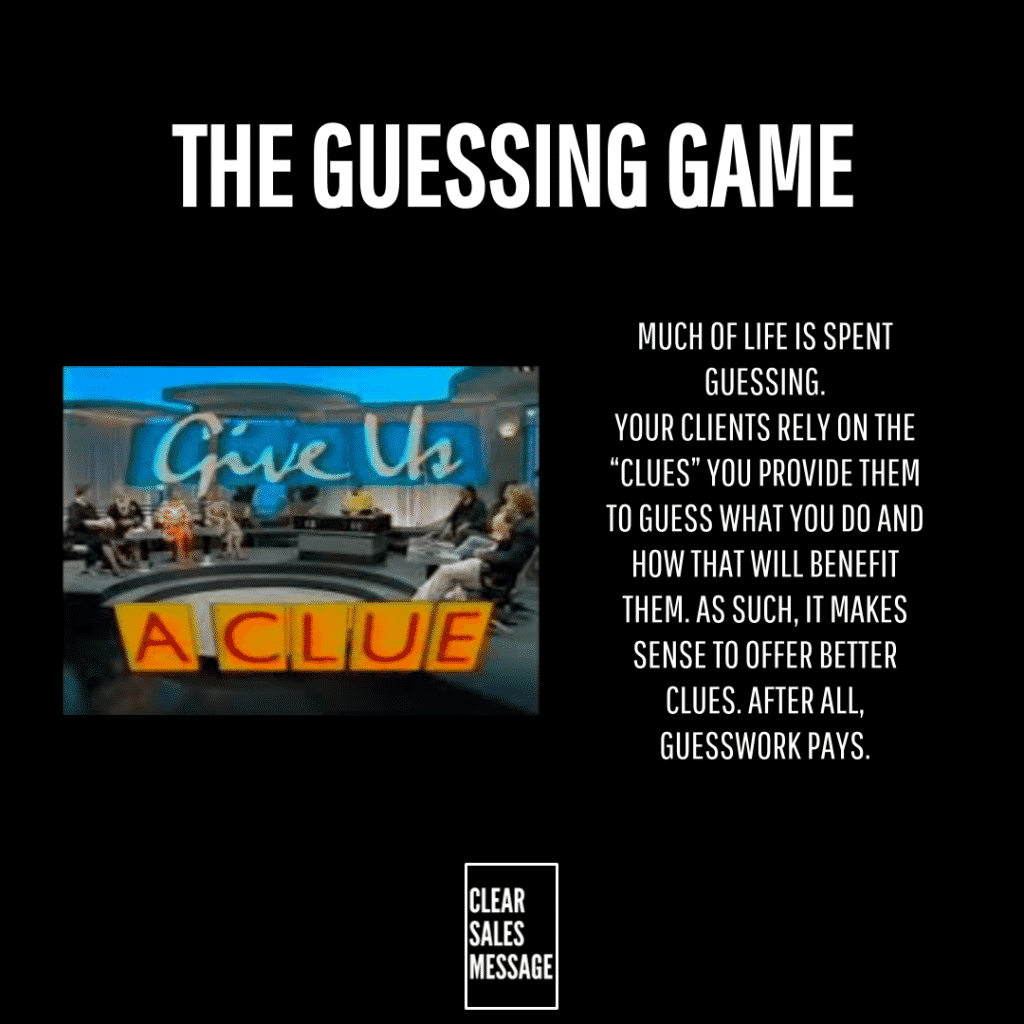
Most buyers don’t fully understand what you do. So they guess. And once they start guessing, you’ve lost control of your own message.
What Is It
The guessing game reminds us that buyers work from limited information. So they connect the dots themselves. As a result, they draw their own conclusions, whether those conclusions are right or wrong.
Why Does It Work
This sits at the heart of sales messaging. In as few words as possible, you need to convey what you do, spark interest, and hold attention. A strong tagline does exactly this.
Think of it like a dot to dot picture. Every piece of information you share adds another dot. So the real question becomes simple: does the full picture add up to the truth about your offer?
How Can You Use It
Try the street test first.
Explain It In One Breath
Could you stop someone in the street and explain what you do in a few words? What would you actually say? If you can’t answer fast, your message probably isn’t clear enough yet.
Choose The Right Dots
Think about which pieces of information, once connected, build the real picture of your offer. Comparing yourself to something familiar helps here, since equivalence gives people an instant shortcut. Covering the obvious basics matters too. This is sometimes called WYSIWYG, and it’s a strong place to start.
When It Works Best
This works best when your offer is genuinely hard to explain in one line. A sharp comparison instantly does the heavy lifting for you.
It also works well in fast attention environments, like social media or a quick pitch, where you only get a few seconds before someone moves on.
When It Becomes Dangerous
This backfires if the dots you give lead to the wrong picture. A buyer who guesses incorrectly ends up disappointed later, even if your pitch felt clever at first.
It’s also risky if you leave out something essential. Missing dots create confusion, and confused buyers rarely convert.
Common Mistakes
Giving Too Few Dots
If you’re too vague, buyers guess randomly. So make sure the essentials are always covered, even in a short pitch.
Overloading With Detail
Too many dots can overwhelm just as easily as too few. So pick the handful that matter most, and leave the rest out.
The Guessing Game – An Example
“We’re Like Airbnb For Meeting Rooms”
A software company describes itself this way to new prospects. Instead of listing features or jargon, one sentence gives the listener an instant shortcut.
Their brain fills in the rest almost automatically. So it’s probably a booking platform. It’s also likely peer to peer. And since Airbnb is easy to use, this probably is too. As a result, it probably feels affordable as well.
The audience connects the dots fast, without needing a full explanation. That’s the guessing game working in your favour, because you guided the guess instead of leaving it to chance.
See also