
Practical Sales Training™ > How to connect with your buyer > Simple Email Reply

Simple Email Reply
Most follow-up emails get ignored. Not because the buyer is not interested. Often because they are busy, they are not sure what to say, and writing a reply feels like more effort than the moment warrants.
So they leave it. They mean to come back to it. They never do.
A Simple Email Reply solves that problem before it starts. Give the buyer a ready-made answer and replying becomes effortless. One keystroke. Done.
What Is a Simple Email Reply?
A Simple Email Reply is a sales email that includes a short numbered list of possible responses. Instead of asking a buyer an open question and waiting for them to compose a reply, you give them two or three options and ask them to reply with just a number.
Each option is written in the first person, from the buyer’s point of view. So it reads as something they could genuinely say, not something you want to hear. The buyer reads the list, finds the one that fits, and types a single digit. That is the entire transaction.
It is a small change to how a follow-up email is written. The difference in response rate can be significant.
Why Does a Simple Email Reply Work?
It works because it follows the path of least resistance. The biggest barrier to replying to a sales email is not that the buyer does not want to. It is that replying requires thought, words, and a decision about what to say. Remove that barrier and you get more replies.
There is also a psychological benefit. When a buyer is given options that include honest responses like “not a priority right now” or “no longer interested,” the email feels respectful rather than pushy. You are not demanding a yes. You are giving them permission to tell you where they stand. That honesty makes buyers more likely to engage, because they know they can say no without an awkward conversation.
The first person framing matters too. When the options are written as “I am interested but need more information” rather than “you might want to know more,” the buyer reads it as their own thought. The reply feels natural rather than forced.
Finally, it qualifies your pipeline. Every reply tells you exactly where the buyer is. A 1 means keep them warm. A 2 means follow up with more detail. A 3 means close the file and move on. No guesswork, no awkward chasing, no wasted time.
How Can You Use a Simple Email Reply In Sales?
Think about the follow-up emails you already send. The ones that ask how someone is getting on, whether they have had a chance to think things over, or whether they are still interested. Now rewrite them using this structure.
Identify the Two or Three Likely Responses
Before you write the email, think about what the buyer is most likely to be feeling. Are they still interested but busy? Have they moved on? Do they need more information before they can decide? Those real possibilities become your numbered options. Keep it to three at most. More than that and you have recreated the friction you were trying to remove.
Write Each Option in the First Person
Each option should read as something the buyer would actually say. “I am interested but it is not a priority right now” is a real human response. “You may wish to defer” is not. Write the options as if the buyer is speaking, and the reply will feel natural rather than transactional.
Include a No Option
Always include an honest exit. A buyer who can reply “I am no longer interested” with a single keystroke will do so. A buyer who has no clean way out will simply ignore the email. Giving people permission to say no gets you honest data and keeps the relationship intact. And occasionally, the buyer who types 3 today becomes a 1 six months from now.
Use It for Follow-Ups Specifically
The Simple Email Reply works best in follow-up situations where the buyer already knows who you are. It is not a cold outreach tool. It is for conversations that have stalled, proposals that have gone quiet, and buyers who have not responded to a previous message. Because the relationship is already established, the numbered reply feels helpful rather than presumptuous.
When a Simple Email Reply Works Best
It works best when a buyer has gone quiet after showing genuine interest. They know who you are, they have been engaged at some point, and the silence probably reflects timing or workload rather than a firm no. A Simple Email Reply gives them a low-effort way back into the conversation without any awkwardness.
It also works well when you have a large number of warm prospects to follow up. Because each reply tells you exactly where the buyer stands, you can triage your pipeline quickly. Spend your time on the ones who reply 1 or 2 and close the ones who reply 3. That clarity saves time and keeps your focus on the deals most likely to move.
When a Simple Email Reply Becomes Dangerous
The main risk is sending it too early. If a buyer has only just received your first contact, a numbered reply list can feel presumptuous. They have not had enough of a conversation to choose from a set of pre-written responses. So use this technique for follow-ups, not introductions.
There is also a tone risk. If the email feels mechanical or template-heavy, the warmth that makes this technique work disappears. The surrounding message needs to feel personal and considered. The numbered options are there to make replying easy, not to replace the human element of the email entirely.
Common Simple Email Reply Mistakes
Writing Options That Only Benefit You
If all three options lead to a follow-up call, you have not given the buyer a genuine choice. The options need to reflect real buyer positions, including ones that do not move the sale forward. A buyer who spots a loaded list will feel manipulated rather than helped. Write options you would genuinely be comfortable receiving.
Too Many Options
Four or five options introduce the same decision paralysis you were trying to remove. Three is almost always enough. Two can work for simpler situations. Keep the list short enough that the buyer can read it in five seconds and make a choice without thinking.
Using It on Cold Prospects
A Simple Email Reply sent to someone who has never heard of you reads as presumptuous. It assumes a level of familiarity that does not exist yet. Save it for warm prospects who already have context and who will read the numbered list as a helpful shortcut rather than a strange unsolicited survey.
Not Following Up on the Reply
A buyer who replies 1 or 2 has done exactly what you asked. If you do not follow up promptly and in a way that reflects their answer, the trust you built with the technique evaporates immediately. Have a response ready for each numbered option before you send the email. Because the whole point is to make the next step easy for both of you, being ready to act on the reply is part of making the method work.
Simple Email Reply – An Example
A follow-up email to a prospect who went quiet after an initial conversation. Rather than asking an open question, the email gives them three numbered options and asks for a single digit reply.
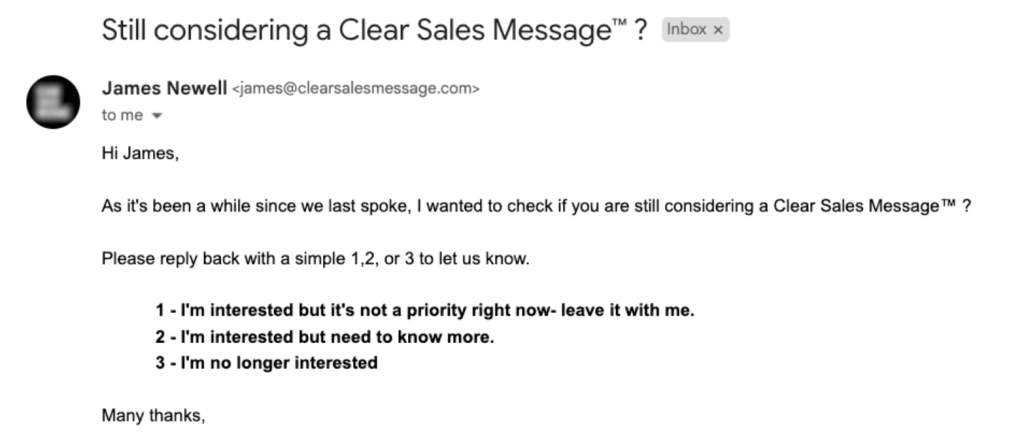
The buyer does not need to think about what to say. They read the options, find the one that matches where they are, and type a number. Ten seconds of effort.
For the seller, every reply is useful. A 1 means keep the relationship warm. A 2 means send more information. A 3 means stop following up and move on. Clear, clean, no ambiguity.
That is the Simple Email Reply at work. Less effort for the buyer. More clarity for you. And a lot more replies than an open-ended follow-up would ever generate.
See Also