
Practical Sales Training™ > How To Connect With Your Buyer > The 1-10 Rating Effect

The 1-10 Rating Effect
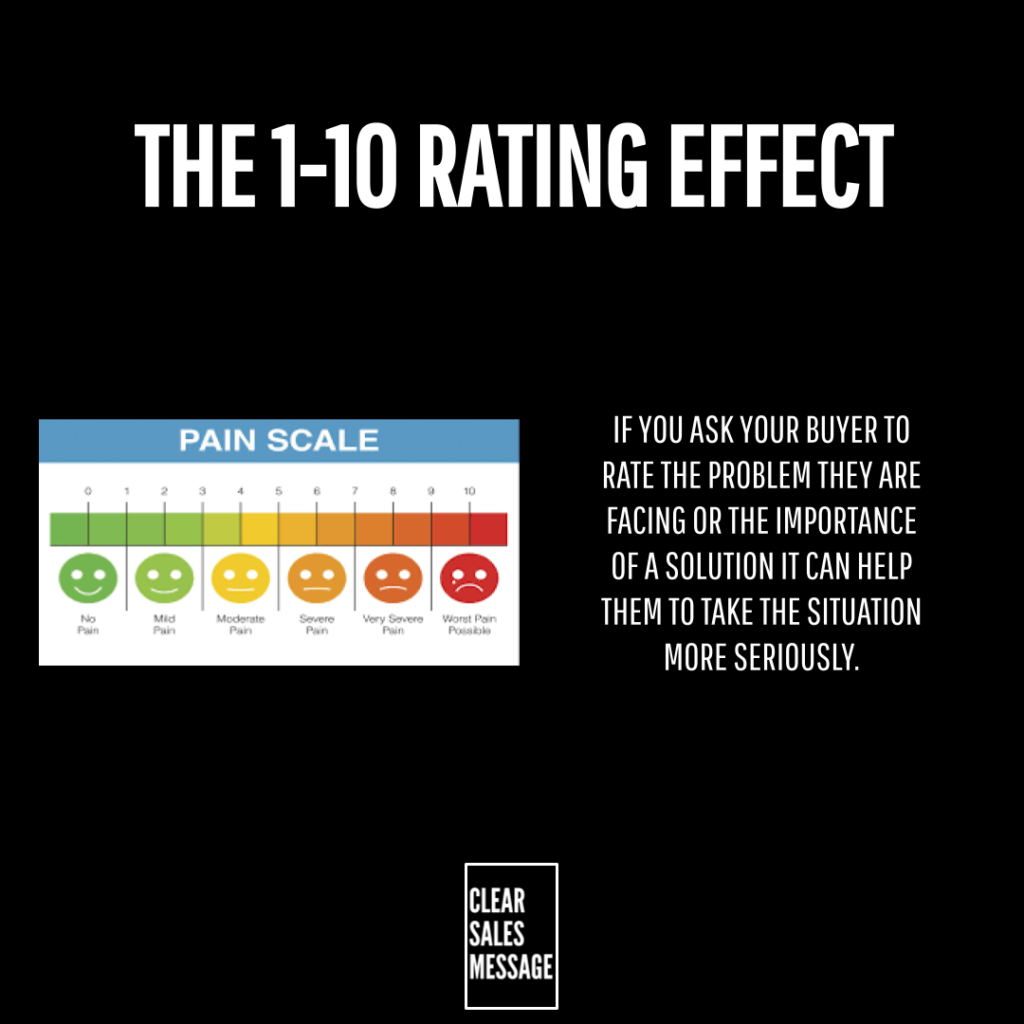
Ask a buyer how important something is and they will tell you it is very important. Rate it out of ten and suddenly you both know where you stand. That is the 1-10 Rating Effect.
A number gives you precision that words never can. Very important could mean anything. An eight means something specific. And once you have a number to work with, you have something you can explore.
The 1-10 Rating Effect is a way of turning an intangible response into a concrete number. It helps you understand how a buyer thinks and feels in a way that vague language never quite does.
What Is The 1-10 Rating Effect?
When someone says something is a problem, you have no idea how big. Rate it seven out of ten and you know it matters, but not enough to have stopped everything else. That context changes how you respond.
Because the buyer commits to a number, they also commit to a position. It is harder to walk back a seven than it is to walk back “very important.” That specificity works in your favour when you want to show how your solution closes the gap.
There is also a clarity effect for the buyer themselves. Answering a scale question forces them to think. The act of rating something can make them realise just how bad things are. That moment of clarity is often what moves the conversation forward.
Why Does The 1-10 Rating Effect Work?
Vague language is comfortable. Saying something is quite bad, or pretty urgent, or reasonably important costs a buyer nothing. They have not committed to anything. But a number is harder to retract. Once a buyer says seven, you can build from it.
It also gives you a shared reference point for the whole conversation. Instead of trading adjectives, you are talking about a number you both understand. That common ground makes it easier to explore what the buyer needs and harder for them to avoid being specific.
Notice how much easier it is to understand where a buyer stands from a rating. Compare these two answers to the same question:
Q: How important is it for you to solve this problem?
A: Very important.
Q: On a scale of 1-10, with 10 being most important, how important is it for you to solve this problem?
A: I would say it’s an 8.
The second answer tells you far more. And it helps the buyer see just how much they need to act.
How Can You Use The 1-10 Rating Effect?
There are two ways to use this in your conversations.
1 – To Establish the Severity of an Issue
When you need to know how serious a problem is, ask for a number. The response tells you where to focus and how much urgency to bring. A three calls for a different response than an eight. Use it early in discovery to calibrate everything that follows.
2 – To Navigate the Solution
If someone tells you it is an eight in terms of how big a problem something is, ask what a nine or ten would look like. Or ask what it would take to get it down to a five. Those questions turn a score into a roadmap. Because the buyer is now describing the solution in their own words, they are far closer to buying it.
A rating system lets you navigate, challenge, and better understand a situation. In turn, that lets you serve your buyer more precisely.
When The 1-10 Rating Effect Works Best
In a discovery call, a scale question cuts through polite vagueness that makes conversations feel circular. You get a real answer fast. You know where to go next. And the buyer knows you are taking their situation seriously enough to quantify it.
It also works well when a buyer seems reluctant to commit to how serious a problem is. A scale question is less confronting than a direct one. Because the buyer is just picking a number, they tend to be more honest. So you often get a truer picture than you would from a standard open question.
It is also useful at the end of a meeting or proposal. Asking a buyer to rate how well your solution fits their needs gives you an honest read on where you stand. A six tells you there is work to do. An eight tells you you are close. Either way, you know what to do next.
When The 1-10 Rating Effect Becomes Dangerous
The main risk is using the scale without following up. A number on its own is not useful. The value comes from what you do with it. If a buyer gives you a four and you move on without exploring it, the technique has done nothing. Always ask what would change the number.
There is also a risk of the buyer giving a number they think you want to hear. Some buyers will adjust the score based on what feels comfortable rather than what is true. Watch for hesitation or inconsistency. When the number does not match the story, probe gently.
Common 1-10 Rating Effect Mistakes
Using It at the Wrong Moment
The most common mistake is asking a rating question when the tone is not right. Dropping a scale question into a warm conversation can feel like a survey if it comes out of nowhere. Frame it first. Tell the buyer why you are asking. That keeps it feeling natural rather than clinical.
Only Using It Once
A second mistake is only using it once. Scale questions are most useful when tracked over time. If a buyer rates at three before working with you and at eight after, that shift tells a story. Use it to measure progress, not just to open conversations.
Not Following Up on the Number
Getting a number and moving on wastes the question. The number is the starting point, not the answer. Ask what the buyer means by it. Ask what would move it up. Ask what is keeping it where it is. Because the follow-up is where the insight lives, the number is just the door.
The 1-10 Rating Effect – An Example
A marketing consultant is speaking with a potential client about their lead numbers. Instead of asking how things are going, they ask: “On a scale of 1-10, how would you rate your current lead results?” The buyer says: “Probably a 3.” The consultant follows up: “What would need to happen for you to feel like you are at an 8 or 9?”
Q: “On a scale of 1-10, how would you rate your satisfaction with your current lead generation results?”
A: “Probably a 3.”
Follow-up: “What would need to happen for you to feel like you’re at an 8 or 9?”
Now the buyer is not describing a problem. They are describing the solution. The consultant knows exactly what to address. That is the 1-10 Rating Effect turning an abstract frustration into a tangible gap they can close.
One simple number. A much clearer conversation.
See Also