

Practical Sales Training™ > How to connect with your buyer > The Repurposing Effect
The Repurposing Effect
What Is It
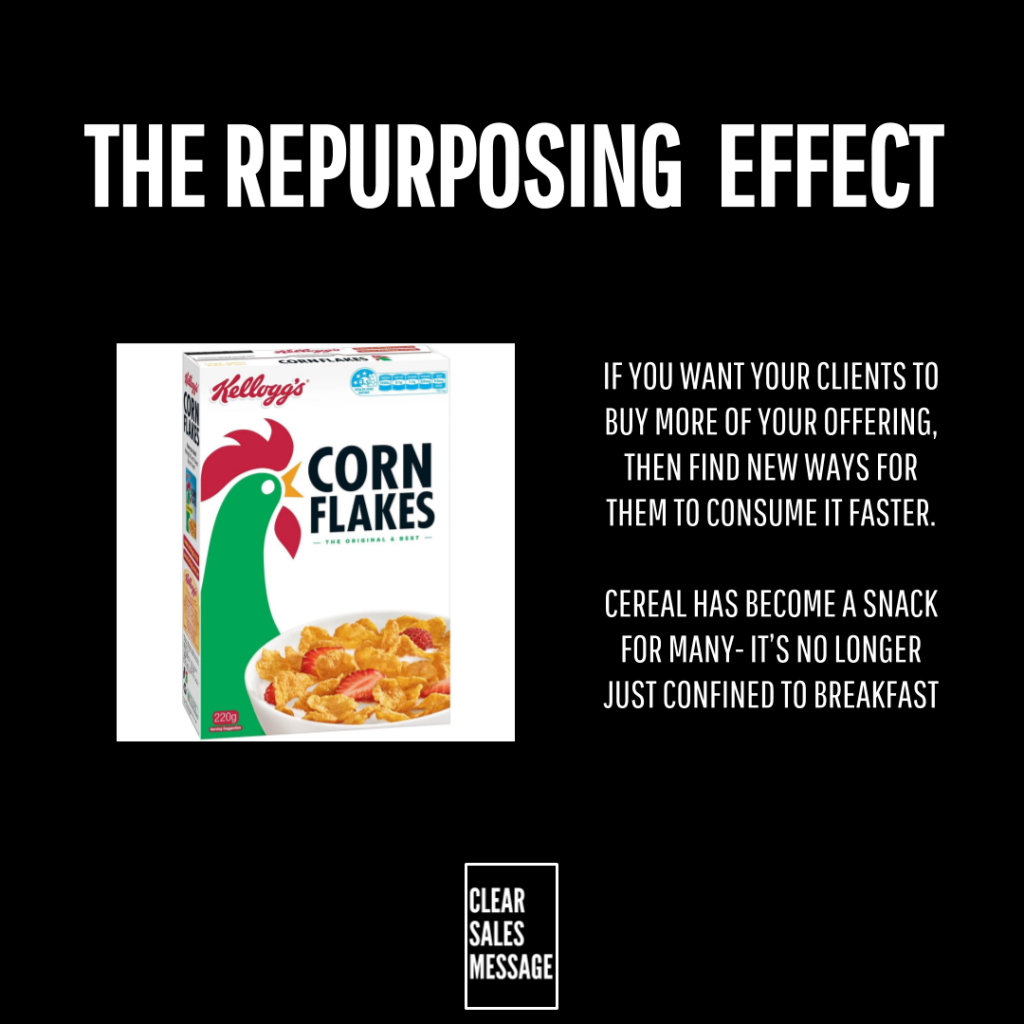
The Repurposing Effect is the process of encouraging clients to consume your offering in new ways. The product stays the same. The use case doesn’t.
It’s a strange kind of growth. You’re not building anything new. You’re pointing at something people already own and showing them another reason to reach for it.
That reframing alone can open up an entirely different market.
Why Does It Work
It works because sometimes we need to be told that we can use products and services in new ways. That’s an example of WYSIWYG, since buyers assume a product does only what it’s shown doing.
Who knew cereal could be a great snack, or that you can use Coca Cola to clean your toilet? That’s a true story. Often, when a product or service gets repurposed, it creates feelings of exclusivity among buyers, and even a sub culture of clients, as shown by the cereal cafes that have popped up across the world.
There’s a novelty effect at play too. A familiar product suddenly used in an unfamiliar way sticks in memory far longer than another new launch ever would.
How Can You Use It
Ask who else could use this exact same thing
If appropriate to your offering, think about how you could encourage clients to consume your products or services in new ways. If you have a personal offering, could it work for businesses? Or, if you have a business offering, could you repurpose it for personal clients?
Flip the usual market variables and see what appears
You can begin by looking at the opposite of the marketplace where you sell, and how your offering gets consumed. Factors like date, time, weather, and gender can all flip to find new potential buyers and repurposing success.
In this spirit, we created Clear Dating Message for singletons looking to portray themselves in the best light. Same underlying skill, completely different audience.
Give the new use a name of its own
A repurposed use case sticks far better when it gets a name or a clear framing, rather than just quietly existing as an unlabelled option. Naming the new use turns it into a decision, not an afterthought.
When It Works Best
This works best when the underlying product genuinely solves a similar problem in a different context. The core value has to actually transfer, not just the marketing.
It also works best when the new use case can spread on its own, through word of mouth, community, or a natural talking point, rather than needing constant paid promotion.
When It Becomes Dangerous
It backfires if the new use case genuinely doesn’t work as well as claimed. A repurposed product that disappoints in its new role damages trust in its original role too.
It also becomes risky if the repurposing confuses your existing customers about what the product is actually for. Too many use cases at once can dilute a clear identity into a vague one.
Chasing every possible new market causes its own problem too. Not every audience is worth pursuing, even if the product technically works for them.
Common Mistakes
Repurposing without any real evidence it works
Suggesting a new use case that hasn’t actually been tested by real customers risks embarrassing failures. Find genuine examples first, then promote them.
Confusing your core market in the process
Marketing too many unrelated use cases at once can leave your original buyers unsure what you’re actually known for. Keep the core identity clear, even while you expand around it.
Assuming the new market wants the product exactly as is
A repurposed use often needs slightly different packaging, pricing, or messaging to land properly. Copying the original approach word for word rarely works in a new context.
The Repurposing Effect – An Example
Listerine Mouthwash
Originally developed in the 1800s as a surgical antiseptic, Listerine was later marketed as a floor cleaner, then a cure for gonorrhoea, before finally getting repurposed as a mouthwash in the 1920s, a move that turned it into a household staple.
The shift wasn’t about changing the formula. It was about changing how people used it.
See also
- Suggested Serving
- The Use Case Effect
- 150+ ways to connect with your buyer
- 30+ ways to encourage repeat business