
Practical Sales Training™ > How To Convert > The Specialist Effect

The Specialist Effect
Most buyers have two questions. Which solution fits my need? And which one carries the least risk? A specialist answers both at once. That is why the Specialist Effect works.
When your business or offer stands for one clear thing, buyers feel safer choosing you. They expect faster results, fewer mistakes, and a smoother ride. So they are often willing to pay more for it too.
The Specialist Effect is about positioning. It means showing buyers that you focus on exactly what they need, rather than offering everything to everyone.
What Is The Specialist Effect?
Buyers want the lowest risk path to a good result. A specialist signals that you have solved this problem many times before. You know the shortcuts. Edge cases are familiar territory. So the chance of a slow or poor outcome drops. That is what makes a specialist feel like the safer bet, even at a higher price.
There is also a speed signal. A specialist can often move faster because they do not need to work things out from scratch. Their systems, contacts, and know-how are already set up for this type of work. Buyers feel that, even before the work begins.
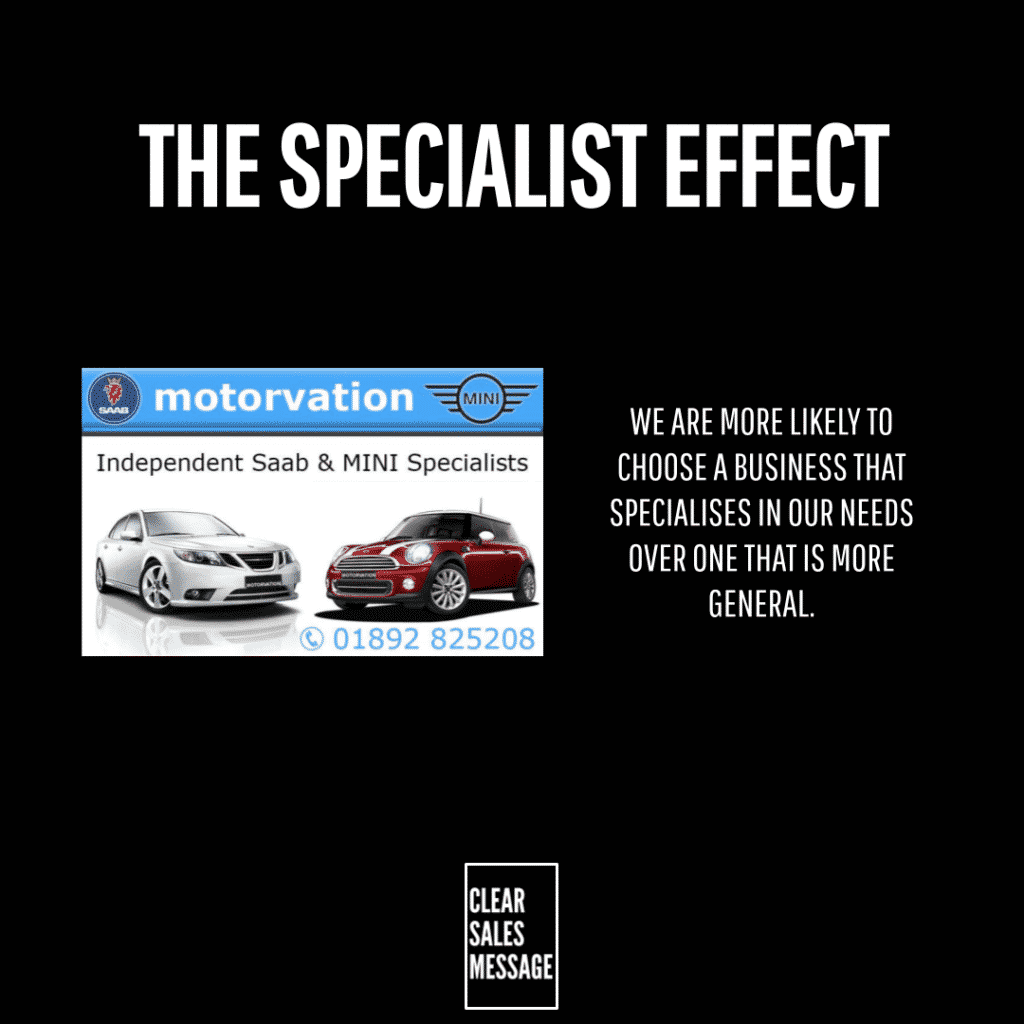
It is also worth knowing how a specialism sits alongside a niche. A niche is about who you work with, the type of buyer or market. Being a specialist is about what you do for them in more detail. Take cars as an example. Cars is the niche. Saab and MINI is the specialism. You can have both, or just one. But the more specific you are, the stronger the signal.
Why Does The Specialist Effect Work?
Buyers carry risk in every decision they make. When they pick a generalist, they wonder whether this firm has really done this before. When they pick a specialist, that doubt shrinks. The track record is right there in the positioning.
There is also a loss aversion angle. Buyers fear a bad outcome more than they value a good one. A specialist reduces that fear directly. So the emotional case for choosing a specialist is often stronger than the logical one.
On top of that, specialists tend to deliver faster results. They have seen the pattern before. They know what works. Because they can anticipate what comes next, the whole process feels smoother. Buyers pay a premium for that feeling.
How Can You Use The Specialist Effect In Sales?
Start by looking at the work you already do. Are most of your best clients in the same sector? Do they tend to bring the same type of problem? If so, you may already have a specialism. You just have not named it yet.
Name the Thing You Do Best
Look at the clients you have already worked with. Notice the patterns. The first step is to put a name to what you already do well, then lead with it. Once you see it, you can lean into it. Change how you describe your offer. Lead with the specific thing you do best. Use language that matches the exact problem your best buyers bring to you. When your message mirrors their situation, the decision feels easy.
Build Your Proof Around That Specialism
Case studies, stats, and testimonials that are specific to one problem carry far more weight than general ones. So if you have done the same type of work many times, you have proof. Use it. A tight body of evidence in one area is more convincing than a broad spread of mixed results.
Let Buyers Self-Select
When your message is specific enough, the right buyers recognise themselves in it. They do not need to be persuaded. Because your language matches their exact situation, the choice feels obvious. Make it easy for them to say yes by making it clear you do exactly what they need.
When The Specialist Effect Works Best
Specialising works best when you already have a track record in one area. If you have done the same type of work many times, you have proof. Use it. The more evidence you can show in that specific area, the more convincing the claim.
It also works well when buyers face high stakes. The more a buyer has to lose, the more a specialist matters. So if your buyers are under pressure or short on time, a clear specialism cuts their fear. It makes the choice easier.
It is also powerful in crowded markets. When lots of rivals offer the same broad service, being the one that does one thing really well stands out. Buyers notice specificity because most businesses avoid it.
When The Specialist Effect Becomes Dangerous
The main risk is narrowing too fast before you have the work to back it up. If you claim a specialism but cannot show depth in that area, buyers will see through it quickly. A specialism needs proof behind it, not just positioning.
There is also a risk of cutting yourself off from good work. If your specialism is too narrow, you may miss buyers who are a good fit. They just do not see themselves in your language. Keep checking that your specialist positioning is bringing in the right kind of work, not just fewer leads.
Common Specialist Effect Mistakes
Being Too Vague About the Specialism
Saying you are a specialist in something broad, like marketing or IT, does not help. The more specific the specialism, the stronger the effect. Buyers need to hear their exact problem reflected back at them. Vague claims are the same as no claim at all.
Burying or Softening Your Focus
A second mistake is softening or burying your specialism. Some sellers worry it will put off buyers outside that area. But the buyers you want will respond faster when they see it clearly. Let them self-select. The ones who are not a fit will leave, which saves everyone time.
No Proof to Support the Claim
Positioning yourself as a specialist without evidence is just a label. Back it up with numbers, case studies, and specific results. Because buyers are already looking for a reason to trust you, proof does that work faster than any amount of positioning copy.
The Specialist Effect – An Example
A plumbing firm looks at its numbers and spots that most of its revenue comes from emergency boiler repairs. So instead of staying a general plumber, it rebuilds its message around one thing.
It calls itself “The Boiler Repair Specialists” and leads with one stat. Ninety percent of boilers fixed on the first visit. Testimonials show real customers who had heat back within hours. As a result, anyone in that city with a broken boiler sees this firm as the obvious call. Even at a higher price than rivals.
That is the Specialist Effect at work. One clear focus. Strong proof. A message that matches the exact fear the buyer has in that moment.
See Also