Practical Sales Training™ >
How To Get Attention >
Cake Mix Selling

Cake Mix Selling
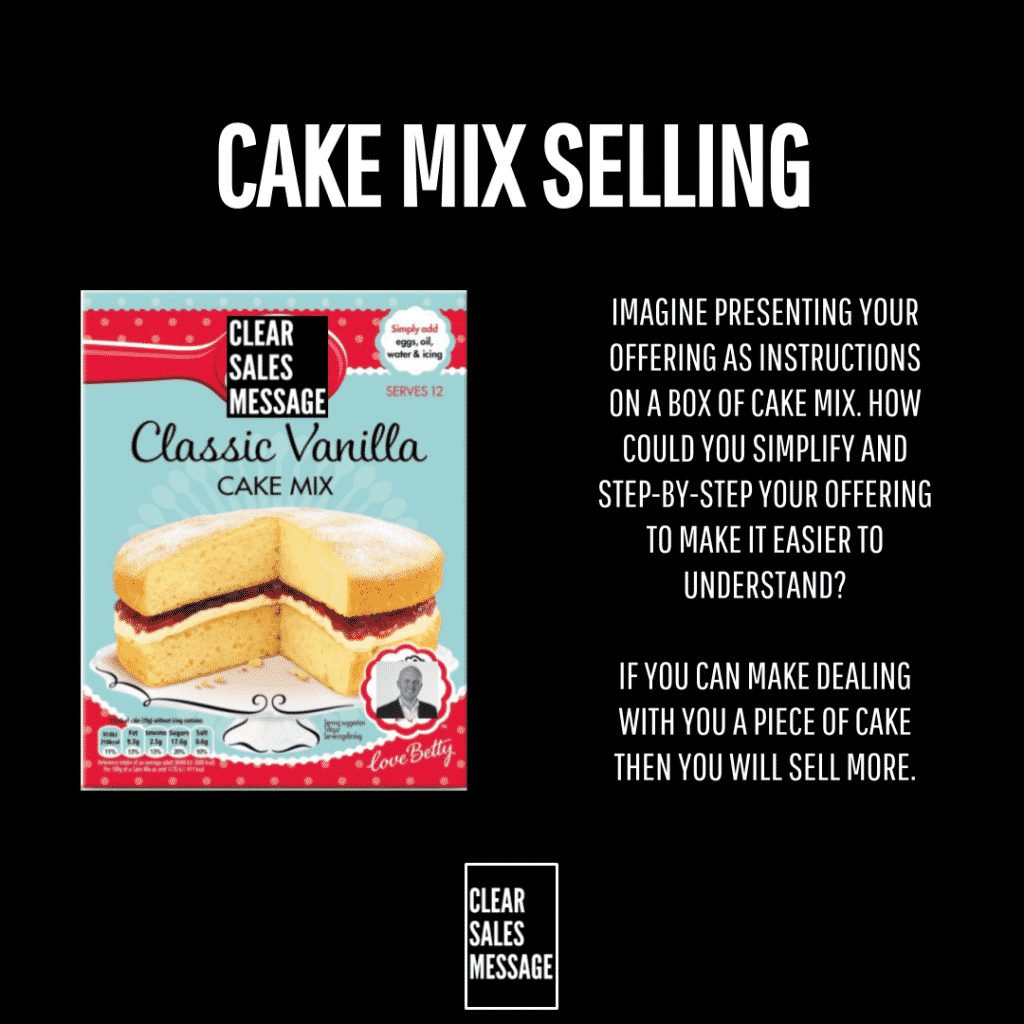
Pick up a box of cake mix. Turn it over. The instructions are short, clear, and so simple a child could follow them. That’s the whole point. Now ask yourself: could you make dealing with you feel that easy?
Most sellers make things harder than they need to be. They explain too much, add too many steps, and give buyers too much to process. So buyers hesitate. They delay. Some walk away.
Cake Mix Selling flips that. You do the work upfront so your buyer doesn’t have to. The result is a process that feels effortless to follow and easy to say yes to.
What Is Cake Mix Selling?
Cake Mix Selling means reducing your offer, process, or message to the simplest form possible. Just like the back of a cake mix box, you give people a short, numbered process they can follow without confusion.
Your offering might be complex. But the buyer doesn’t need to see all of that complexity. They just need to know what to do next. So you strip it back, number the steps, and make it look easy.
The goal is to remove every reason a buyer might hesitate. If it looks hard, they stop. If it looks simple, they start.
Why Does Cake Mix Selling Work?
It works because of the path of least resistance. People move toward the easiest option available. When you make your process clear and simple, you become the easiest option.
Complexity creates doubt. If a buyer has to work hard to understand what you do or how to get started, they start to wonder if it will always feel this difficult. However, when your process looks clean and obvious, they feel confident. That confidence converts.
Also, buyers are busy. They don’t want to think more than they have to. So when you do the thinking for them, they reward you with their time, trust, and eventually their money.
How Can You Use Cake Mix Selling In Sales?
Start by looking at how you currently explain your offer. Count the steps. Count the decisions. Then cut them down.
Make your process look short
Three steps beats twelve every time. Even if twelve steps exist behind the scenes, the buyer only needs to see the three that matter to them. Group your complexity. Hide the noise. Show only the path forward.
Use numbers and labels
Numbers tell buyers where they are in a process. Labels tell them what each step involves. Together, they create structure that feels safe and easy to follow. For example, Step 1: Choose. Step 2: Start. Step 3: See results.
Use visuals where you can
A simple diagram or one-page summary can do more than a ten-slide deck. Visuals reduce thinking. So if you can show the process instead of explain it, do that instead.
Apply it to your messaging too
Your pitch, your proposal, your emails. All of them benefit from this approach. The simpler your message, the faster people get it. And the faster they get it, the sooner they can buy.
When Cake Mix Selling Works Best
This approach works best when buyers are new to what you do. If they don’t fully understand your market or your method, a clean simple process helps them trust that they can handle it.
It also works well in competitive situations. When a buyer is weighing up two similar offers, the one that looks easier to get started with often wins. Simplicity feels like confidence. And confidence is compelling.
Similarly, it helps when your sales cycle is long. Breaking a big commitment into small visible steps makes the whole thing feel less daunting. Buyers can see where they are and what comes next. That keeps them moving.
When Cake Mix Selling Becomes Dangerous
Oversimplifying can cause problems. If you make something sound so easy that reality doesn’t match the promise, you lose trust fast. So the simplicity must be real, not just a sales trick.
There’s also a risk with highly technical buyers. Some buyers want depth. They want to see the detail before they commit. In that case, lead with the simple version but be ready to go deeper when they ask. Don’t strip out all the substance just to look clean.
Also, be careful not to hide important steps that affect the buyer’s time or effort. If something genuinely requires work on their side, say so. Surprising them later costs you far more than being upfront.
Common Cake Mix Selling Mistakes
Keeping the complexity visible
You know your process inside out. But that can make it hard to see what the buyer actually needs to see. Share the simple version first. Save the depth for when they ask.
Using steps that are really sub-steps
If step one has four parts, it’s not one step. Group properly or you lose the clarity you’re trying to create. Buyers notice when “simple” still looks complicated.
Applying it only to the product
Cake Mix Selling applies to your whole process. Not just what you deliver, but how you sell it. So simplify your proposal, your onboarding, your follow-up, and your ask. Every touchpoint is a chance to make it easier.
Making it look simple but not feel simple
Three steps that are full of jargon is not Cake Mix Selling. The words have to be plain too. Use the language your buyer uses, not the language your industry uses.
Cake Mix Selling – An Example
A digital marketing consultant offers a complex 12-step lead generation strategy. But when they explain it to potential clients, people lose interest fast. It sounds overwhelming and complicated.
So the consultant creates a cake mix style process instead:
-
Choose your audience (Step 1).
-
Launch your first ad (Step 2).
-
Follow up with our email template (Step 3).
Each step is simple, numbered, and actionable, just like the back of a cake mix box. As a result, clients feel confident they can follow it. And the consultant’s conversion rate improves because the process no longer feels like a risk.
See Also