Practical Sales Training™ > Selling Communication Basics > Clustering

Clustering
When you share information in a random order, buyers have to work hard. They’re connecting dots that shouldn’t need connecting. The harder you make it, the more likely they are to give up.
Clustering removes that problem. You group related information together. Buyers can see how things connect and what each section is about. It becomes easy to follow.
Most people don’t apply it consistently. So proposals, pitches, and emails often feel harder to read than they need to be. Clustering fixes that before the buyer even notices there was a problem.
What Is Clustering?
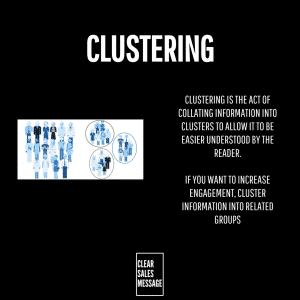
Clustering means grouping similar things together, such as information, services, or ideas, so they’re easier to understand. Instead of listing items in the order they come to mind, you group them by theme or purpose.
The result is content that reads like a clear conversation. Each cluster covers a set of related ideas. The reader moves through without jumping between different trains of thought.
In sales, clustering applies to proposals, emails, and presentations. Wherever you share a list or a set of points, you have a chance to cluster and make it clearer.
Why Does Clustering Work?
It works because the brain finds grouped information easier to process. When related items sit together, attention stays focused on one theme at a time. That focus makes things faster to read and easier to remember.
It also signals structure. A well-clustered document looks considered and professional. Buyers feel they’re in safe hands. That impression builds trust before a single word of content lands.
Similarly, clustering keeps buyers engaged for longer. A random list forces constant mental effort. However, a well-grouped sequence feels like a natural flow. Readers stay with something that feels easy far longer than something that feels like work.
How Can You Use Clustering In Sales?
Whenever you share information with a potential client, especially a list, group similar items together. Give your buyer the best chance of following your thinking. The burden of proof is always on you.
Use it in proposals
Don’t list services in the order you thought of them. Group them under clear headings instead. For example, separate your discovery, delivery, and support into distinct sections. Each cluster then tells its own mini story. Buyers can follow and evaluate each one on its own terms.
Use it in presentations
Presentations that jump between unrelated points lose audiences fast. So build your slides around clusters of related ideas. Add a clear transition between each group. Buyers will follow the logic more easily and remember more of what you said.
Use it in emails
A long email covering multiple topics is hard to read as one block of text. Instead, cluster related points under short headings or clear paragraph breaks. The email becomes easier to scan, respond to, and act on.
Use it on your website
Service pages often list things the way the business thinks about them. But buyers think about their problems, not your structure. Rearrange content into clusters that match the buyer’s questions. The page will perform better as a result.
When Clustering Works Best
Clustering works best when you have a lot to share and the buyer needs to absorb it fast. The more complex your offer, the more a clear structure helps. Complexity without clustering feels overwhelming. Complexity with clustering feels manageable.
It’s also powerful in competitive situations. When a buyer compares two proposals side by side, the easier one to read wins. A clustered document signals that you communicate well. That’s a proxy for how you’ll work with them day to day.
Similarly, it helps when you’re selling to groups. Different people focus on different sections. Well-defined clusters let each person find what they care about. Nobody gets lost.
When Clustering Becomes Dangerous
Clustering causes problems when the groupings don’t reflect how the buyer thinks. If you create clusters based on your internal logic, the structure may feel tidy to you but confusing to them. Build your clusters around the reader’s needs, not your own.
Over-clustering is also a risk. Too many small groups with too many headings creates noise. The goal is a small number of clear clusters. Fewer and larger almost always works better than many small ones.
And clustering doesn’t fix weak content. If the information itself is unclear, grouping it neatly won’t save it. Therefore, get the content right first, then apply the structure.
Common Clustering Mistakes
Grouping by your process, not the buyer’s problem
It’s tempting to cluster things the way your business is structured. But buyers care about their challenges and outcomes, not your internal categories. Build your clusters around what matters to them.
Using headings that don’t add meaning
A heading like “Section 2” tells the reader nothing. Labels should explain what the cluster covers and why it matters. “How we reduce your risk” is far more useful than a numbered title with no context.
Mixing unrelated items into the same cluster
If a cluster contains items that don’t belong together, you create the same confusion you were trying to avoid. Each group needs one clear theme. When something doesn’t fit neatly, it probably belongs elsewhere.
Applying it only to written documents
Clustering matters just as much in spoken presentations and sales calls. If you jump between unrelated topics in a meeting, buyers lose the thread. So think about how you cluster your spoken points too, not just the ones on paper.
Clustering – An Example
A marketing consultant sends a proposal listing services in a random order:
- SEO strategy
- Social media management
- PPC advertising
- Brand storytelling
- Email automation
The list feels disconnected and hard to follow. The client can’t see how the services fit together or why they all matter.
So the consultant reorganises by clustering related services together:
Digital Visibility: SEO strategy, PPC advertising
Brand Engagement: Social media management, brand storytelling
Conversion: Email automation
The proposal becomes easier to follow and more persuasive. Because each cluster solves a specific problem, the whole offer makes more sense. It’s easier to say yes to something you can clearly understand.
See Also