

Practical Sales Training™ > How To Get Attention > Family of Names
Family of Names
Most businesses name their products independently, without any thought for how the names work together. So each product is memorable on its own terms, but the range as a whole feels disconnected. Buyers have to learn each name separately, and the naming does no work for the brand.
A Family of Names fixes this. When every product shares a common word or element, the names start to reinforce each other. Learn one and you are halfway to knowing the rest. Over time, buyers can even guess the names of products they have never seen, simply because the pattern is familiar.
It is a simple idea, but a powerful one. And it is one that most businesses never think to apply.
What Is a Family of Names?
A Family of Names is a naming system where every product in a range shares a common word or element. The shared element acts as a brand anchor, tying the range together and making it instantly recognisable.
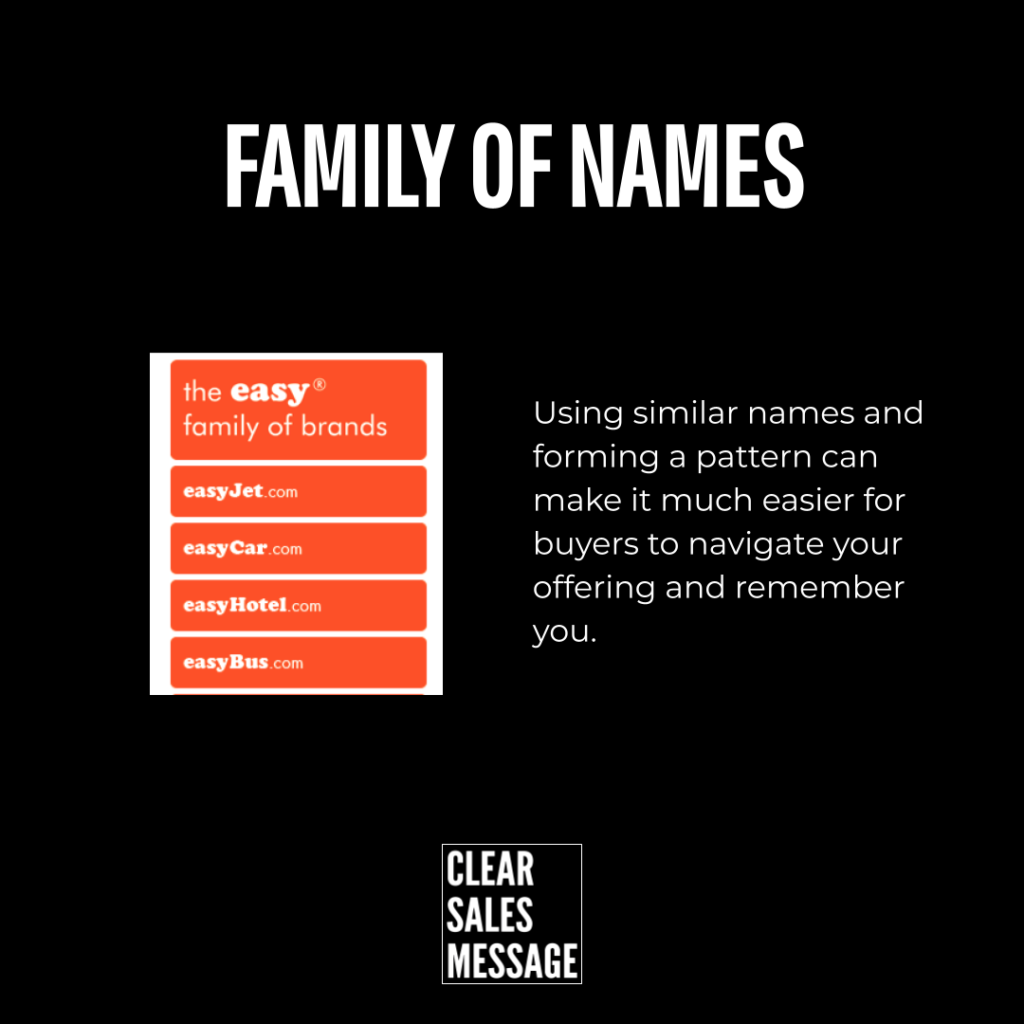
EasyJet and EasyHotel are a well-known example. Both names tell you what the product does and signal the brand at the same time. EasyGroup has taken this to an extreme, building dozens of “Easy” companies across multiple sectors. They protect the term fiercely because the shared name is a core part of their value.
The concept also applies at a smaller scale. A consultant might offer CLEAR Sales Message and CLEAR Sales Process. Similarly, a supplement brand might run Pre-Protein, Pre-Carbs, and Pre-Greens. In each case, the shared element does the work of linking and labelling the range.
Why Does a Family of Names Work?
It works because the brain naturally looks for patterns. When buyers see a new name that follows a familiar pattern, they connect it to the brand immediately. So the new product benefits from all the trust and familiarity the existing one has already built.
It also works because repetition builds memory. Every time a buyer hears or sees the shared element, it reinforces the whole range. So the more products in the family, the stronger the effect. Each new name makes all the others easier to recall.
And it gives buyers a sense of the whole. When names are consistent, buyers can often work out what a product does before they even look at it. That reduces the effort of understanding, which removes a barrier to engagement. And reduced friction means more buyers stay long enough to consider buying.
How Can You Use a Family of Names?
Choose a prefix or a suffix
Decide whether the shared word comes first or last. A prefix puts it before the product name, for example CLEAR Sales Message or CLEAR Sales Process. Putting it after gives you options like Selling Confidence or Prospecting Confidence. Either works. The question is which sounds more natural and which fits better with how you describe the products.
Choose between a feeling word and a descriptive word
The shared element can be a feeling word like Confidence or Pride, or a descriptor like Simple, Fast, or Green. Feeling words tend to appeal to buyers emotionally and work well for service businesses. Descriptive words tend to communicate what the product does or how it differs and work well for product ranges. Think about what your buyers care most about and let that guide the choice.
Use a shared prefix or suffix at word level
Another option is to build the shared element into the structure of the word itself. A weight loss brand might prefix each name with “Pre” to signal it is taken before food: Pre-Protein, Pre-Carbs, Pre-Greens. This approach works well when the shared element carries meaning beyond just brand recognition. It adds information as well as identity.
Apply it consistently and protect it
You apply it consistently. Every new product or service that joins the range should follow the pattern without exception. And if your shared element is distinctive enough, consider protecting it as a trademark. EasyGroup does this aggressively because the naming system is central to their entire brand value.
When a Family of Names Works Best
It works best when you have a range of products or services that serve the same broad audience. The more a buyer interacts with the range, the stronger the pattern and the harder the name works for you. So it is especially valuable for businesses that sell to repeat buyers or want to cross-sell across a range.
It also works well when you are entering a market where buyers may not know you yet. A consistent naming system signals that you are an established, organised brand, even when you are relatively new. It creates a sense of depth and structure that a disconnected set of product names never will.
And it works in any sector. The principle is the same whether you are naming software tools, food products, consulting services, or retail lines. What matters is that the shared element is relevant, memorable, and genuinely connected to what you stand for.
When a Family of Names Becomes Dangerous
The biggest risk is choosing a shared element that is too generic to stand out. If anyone can use your shared word, it provides no real protection and does little to set you apart. So choose something specific enough to be ownable, even if you do not formally trademark it.
There is also a risk of over-extending the family. When you apply the same name to too many things, the individual products start to lose their identity. Buyers may struggle to distinguish between them, especially if the descriptive parts of the names are also similar. So keep the product names distinct enough that the family works as a system rather than a blur.
Finally, be aware that a strong Family of Names can become a constraint. As your business grows, you may want to launch products that do not fit the existing naming pattern. At that point, the choice is between breaking the system or limiting what you can offer. So think ahead when you build the family and give yourself room to grow.
Common Family of Names Mistakes
Choosing a shared element that is too weak
A shared element only adds value if it is distinctive. Before you commit, check how many other businesses use the same word. The less competition on that term, the more powerful it will be for you.
Applying the system inconsistently
A Family of Names only builds over time when every product follows the pattern. So if some products follow the family and others do not, the pattern loses its power. Buyers cannot learn the system because the system keeps breaking. So decide on the approach before you name anything new and apply it without exception from that point forward.
Forgetting to protect it
If your Family of Names becomes recognisable, other businesses may start using the same element. This is especially common with descriptive or feeling words that seem general enough to use freely. So monitor how your market uses your shared element and protect it if it starts to gain real value. EasyGroup has spent considerable effort defending the “Easy” name for exactly this reason.
Family of Names – An Example
EasyGroup: the most extreme example
EasyGroup started with EasyJet and has since expanded into dozens of sectors: EasyHotel, EasyCar, EasyBus, and more. Each name tells you exactly what the product does and signals the brand at the same time. Buyers who know one EasyGroup product immediately understand the positioning of any new one.
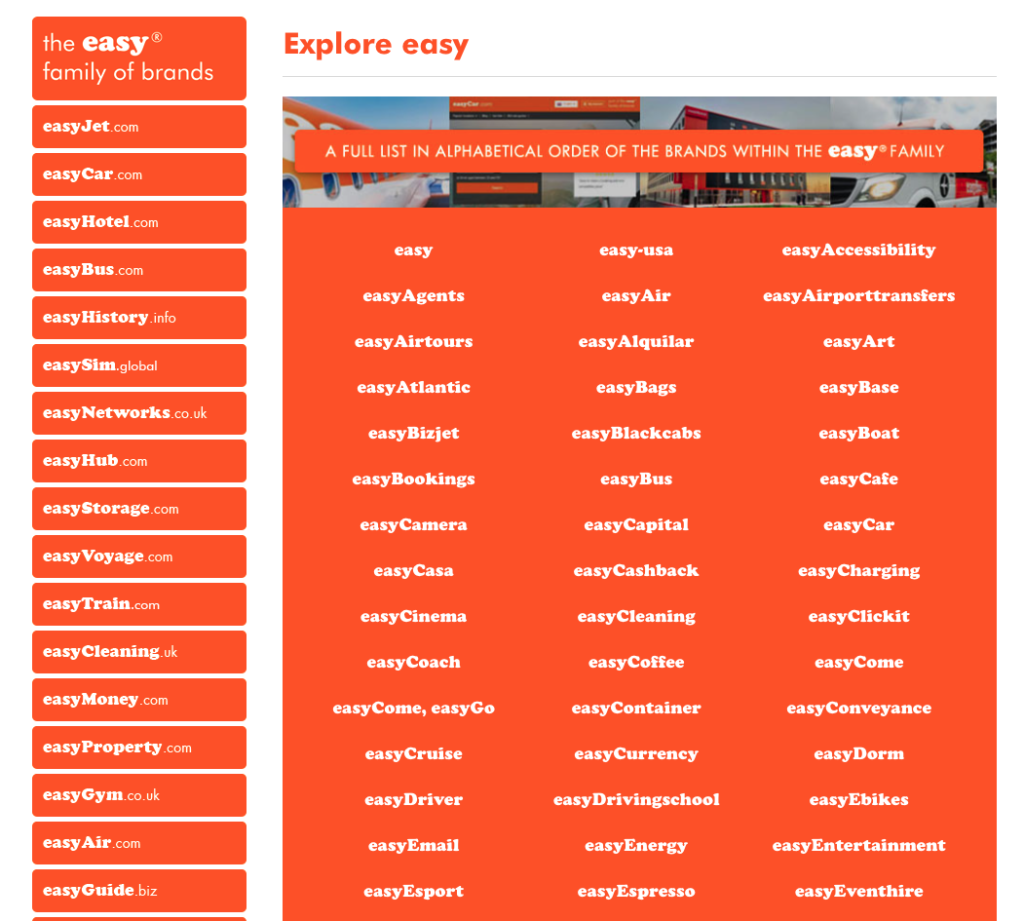
The shared element does multiple jobs at once. It builds recognition, communicates the brand promise, and makes the whole range easier to remember. So each new product launch benefits from the awareness of every product that came before it. That is the Family of Names working exactly as it should.
See Also