
Practical Sales Training™ > How to connect with your buyer > Price in the Name

Price in the Name
Price is one of the first things buyers want to know. Before they ask about features, before they think about timing, they want to know what it costs. So when your name or tagline answers that question instantly, you remove the friction before it even exists.
Most businesses hide their prices until late in the conversation. That creates hesitation. Buyers who do not know what something costs have to ask, wait for a quote, or go and look it up. Each of those steps is a chance for them to drift away or choose someone else. Price in the Name removes all of that.
It is a simple idea, but a bold one. When you put your price in your name, you are making a commitment in public. You are telling buyers exactly what to expect, and that confidence is its own selling point.
What Is Price in the Name?
Price in the Name is when you include the price of your product or service directly in the name of your business, your offer, or your tagline. The buyer does not need to ask. The cost is communicated as part of the brand itself.
This works especially well when you have a fixed, productised offering. Because the price does not change from buyer to buyer, building it into the name is accurate, consistent, and removes any risk of a Chinese Whisper situation where the price gets lost or distorted as it passes from person to person.
The concept applies to product names, service packages, and taglines. It does not suit every business. But where it fits, it is one of the clearest and most direct ways to communicate value and remove the price conversation before it becomes a barrier.
Why Does Price in the Name Work?
It works because price is often the biggest hurdle between a browser and a buyer. When buyers do not know what something costs, uncertainty grows. They start to wonder if it is affordable, whether they need to negotiate, or if they will be judged for asking. Price in the Name wipes out all of that uncertainty in an instant.
There is also a filtering effect. When the price is visible from the start, only buyers for whom that price works will engage. Because those buyers already know the cost and are still interested, they are warmer prospects from the first contact. You spend less time on people who were never going to buy at that price, and more time on those who will.
For price-sensitive buyers, particularly in B2C settings, a visible price is also a trust signal. It says you have nothing to hide. It signals confidence in the value of what you offer. And it makes the whole experience feel more straightforward, which buyers appreciate in a world full of vague pricing and hidden fees.
Finally, Price in the Name supports word of mouth. When your price is part of your name or tagline, it travels with the recommendation. Someone who tells a friend about you automatically communicates the price at the same time. That means your message arrives intact rather than distorted.
How Can You Use Price in the Name In Sales?
This approach works best when your pricing is fixed and consistent. Variable pricing or bespoke quotes do not lend themselves to this technique. But if you have a clear, set price for a product or service, there are several ways to build it in.
Name Your Offer Around the Price
If your pricing is a key part of the appeal, consider naming the offer to reflect it. A flat-fee service, a fixed-price package, or a set-cost product can all benefit from having the price built into what it is called. Because the name does the communication work, buyers arrive already knowing the cost and already having decided it works for them.
Use It in Your Tagline
When including the price in the name itself is not practical, a tagline can do the same job. “Full website build, fixed at £1,500” or “Monthly social media management for £299” communicates the price clearly without making it the entire brand identity. The tagline appears wherever the name does, so the price travels with it.
Productise Your Offering First
Price in the Name only works when the offer is clearly defined. If what you sell varies significantly from client to client, the price will too, and building a number into the name will cause confusion. So before you use this approach, make sure you have a productised offer with a fixed scope and a fixed price. Then the name can do its job cleanly.
Use It Across All Channels
Once the price is in the name or tagline, use it consistently. On your website, in your social media bio, in your email signature, and in any printed material. Because the goal is to make the price unavoidable so buyers always know it, consistency is what makes the approach work. A price that appears only occasionally is easy to miss. One that appears everywhere becomes part of how people know you.
When Price in the Name Works Best
This approach works best when price is a primary buying factor and your offer is fixed and well-defined. Consumer-facing businesses, flat-fee service providers, and fixed-price product ranges are all strong fits. Because buyers in these contexts often make quick decisions based on price, having it front and centre removes the main obstacle to conversion.
It also works well when you want to stand out in a crowded market where competitors are vague about their pricing. When everyone else asks buyers to “get in touch for a quote,” a visible price is a point of difference. It attracts buyers who value transparency and who are ready to decide rather than spend time comparing vague options.
Similarly, it works well for referral-based businesses. When your price is memorable and built into your name or tagline, the people who refer you can share the price as naturally as they share the name. That makes every referral more complete and more likely to convert.
When Price in the Name Becomes Dangerous
The biggest risk is locking yourself into a price that no longer works. When the price is embedded in your name or tagline, changing it becomes complicated. Buyers who know you by that price will notice the change and may feel misled. So think carefully before you commit to a price in your name, and make sure it is one you can sustain long term.
There is also a risk of attracting only price-driven buyers. When price is the most prominent thing about your brand, buyers who are primarily motivated by cost will find you first. That is fine if price competitiveness is your strategy. But if you want to compete on quality, expertise, or results, leading with price can attract the wrong audience and make it harder to hold your rates over time.
Common Price in the Name Mistakes
Using It Without a Fixed Offer
Price in the Name only works when the price is consistent. If your actual pricing varies, putting a number in your name creates confusion and erodes trust the moment a buyer receives a quote that differs from what they expected. So get the offer fixed and clear before you commit the price to the name.
Choosing a Price That Is Hard to Sustain
Some businesses build a price into their name that was right at launch but becomes impossible to hold as costs rise. Because changing a name is far harder than adjusting a price list, this can trap you. So when you choose the price to include, make sure it works not just today but over the medium to long term.
Not Using It Consistently
The value of Price in the Name comes from repetition. A price buried on a pricing page does not achieve the same thing. For the approach to work, the price needs to appear with the name every time. So build it into every place your brand appears and treat it as a permanent part of how you communicate.
Applying It to a Variable Service
Bespoke services, consultancy work, and anything that changes significantly from client to client are poor fits for this technique. When buyers arrive expecting a fixed price and find out the real cost depends on their situation, the disconnect damages trust. Save Price in the Name for offerings that are genuinely consistent in scope and cost.
Price in the Name – An Example
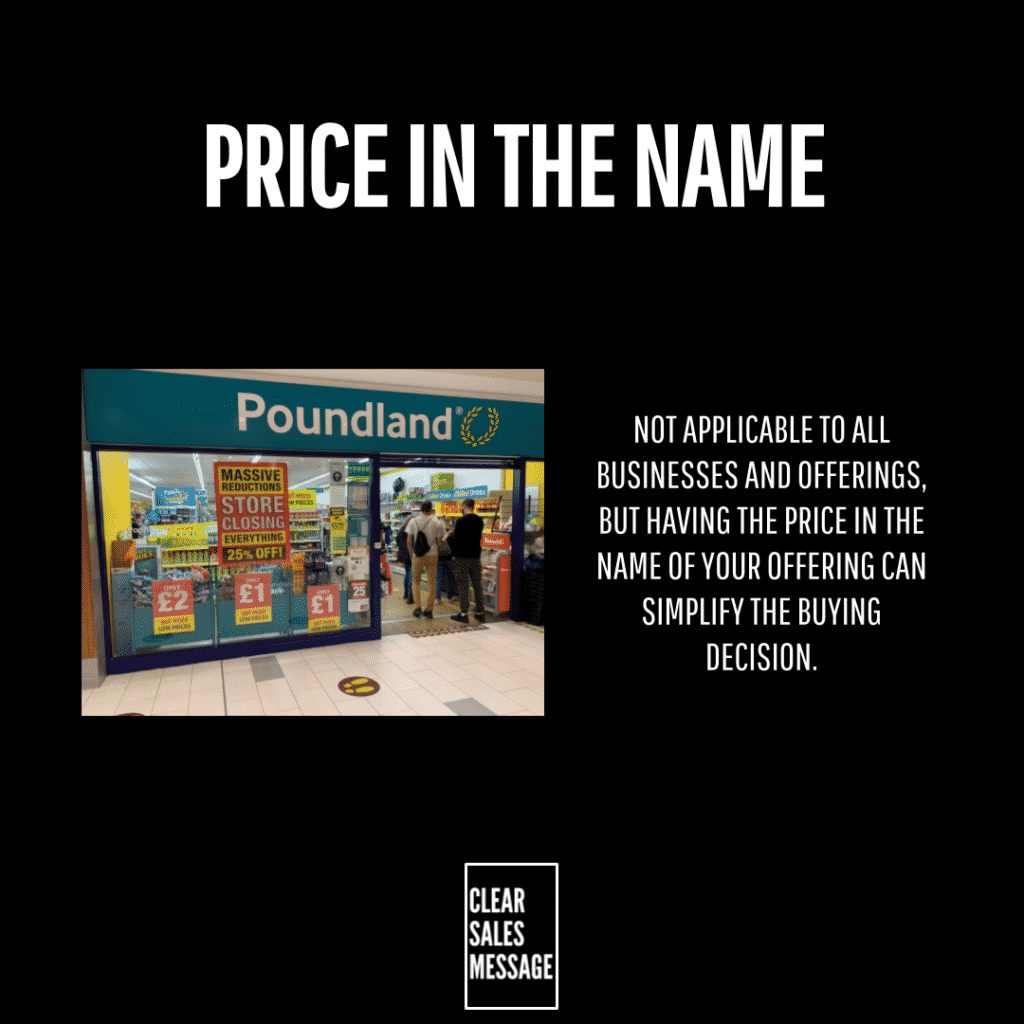
Poundland is the clearest example of Price in the Name working at scale. The name tells buyers everything they need to know before they walk through the door. Every item costs £1. There is nothing to ask, nothing to compare, and no uncertainty about whether you can afford it.
Other retailers have used the same approach. Dollar Tree and Five Below in the US, and 99p Stores in the UK, all built their price point into their identity from the start. Because the price is the promise, buyers know exactly what they are getting before they engage. That clarity removes friction and makes the buying decision almost automatic for anyone the price suits.
The lesson for any business is simple. When your price is a strength, do not hide it. Build it into how you present yourself and let it do the filtering work for you.
See Also
- The Vernacular
- Family of Names
- 150+ ways to connect with your buyer
- 100+ ways to be more memorable
- One Price Sale