
Practical Sales Training™ > How To Convert > Option Packages

Option Packages
Give a buyer too many individual choices and they often make no choice at all. The more decisions they face, the more likely they are to pause, overthink, and walk away. That is not indecision. That is a natural response to too much complexity.
Option Packages solve that problem by doing the thinking for the buyer. Instead of a long list of individual options, you present a small number of curated bundles. Each one speaks to a type of buyer or a desired outcome. The buyer picks the one that fits and moves forward.
Fewer decisions, faster conversions, happier buyers.
What Are Option Packages?
Option Packages are pre-built bundles that group together a set of related options, features, or services around a common theme or outcome. Rather than asking buyers to build their own configuration from scratch, you do the curation for them.
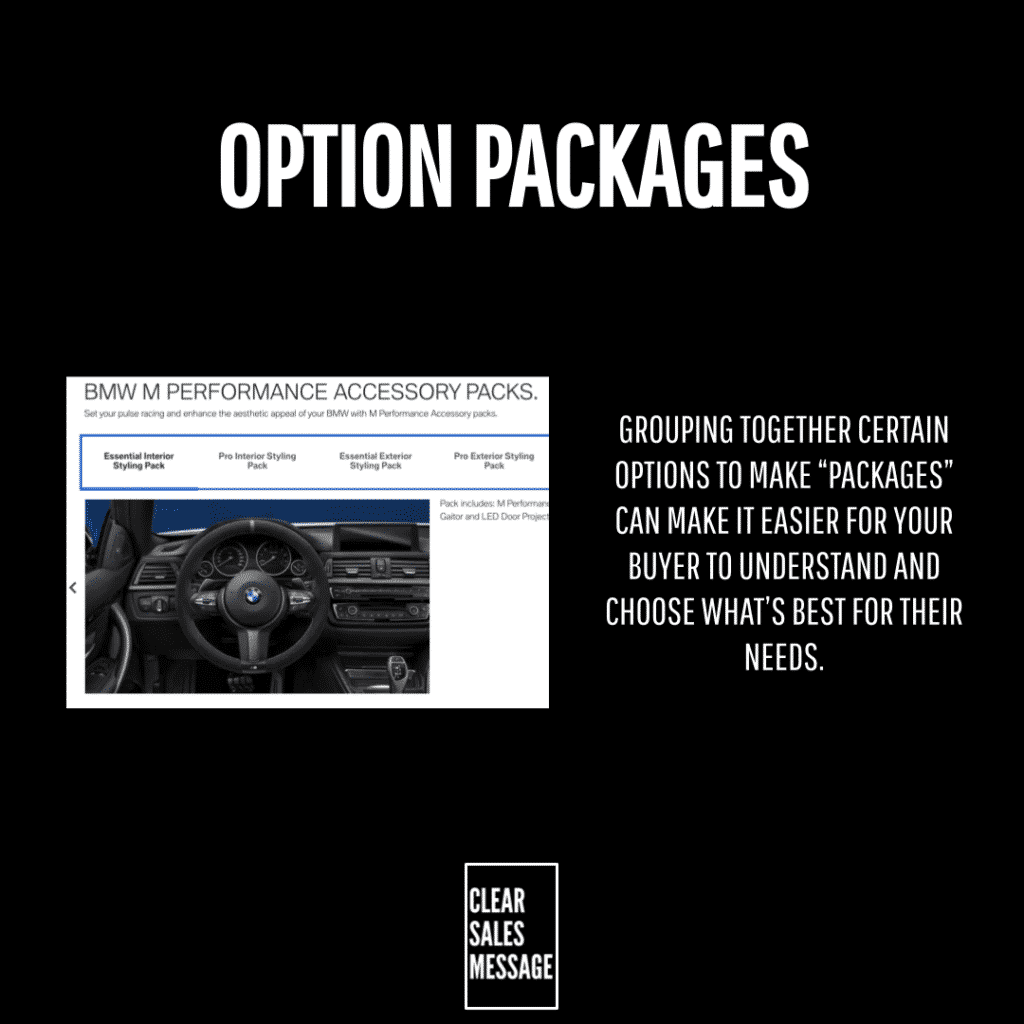
The car industry uses this well. A “Sport Package” might combine performance tyres, lowered suspension, and a body kit. A “Comfort Package” might bundle heated seats, ambient lighting, and a premium sound system. The buyer knows what they want to feel. The package gives them the fastest route to that feeling without picking every component individually.
Why Do Option Packages Work?
They work because buyers find it much easier to choose between a small number of clear outcomes than to build something from a long list of parts. When you present three well-named packages, the buyer asks themselves which one sounds most like them. That is a simple question with a quick answer.
Option Packages also work because they tap into the same appeal as a bundled deal or a mega pack. Buyers feel they are getting a considered, complete solution rather than a collection of parts. The package feels like an answer, not a list. And answers convert better than lists.
There is also a confidence factor. Pre-selected defaults reduce the fear of making the wrong choice. When an expert has already grouped the right things together, the buyer trusts the recommendation and commits faster.
How Can You Use Option Packages In Sales?
Start With Buyer Outcomes, Not Product Features
The best Option Packages start with the question: what does this type of buyer want to achieve? Build each package around an outcome or a feeling, not a feature set. A buyer choosing a “luxury” package wants to feel premium. A buyer choosing a “budget” package wants value. Name the package after what the buyer wants, not what it contains.
Keep the Number of Packages Small
Three packages almost always outperform five or more. Too many options reintroduces the decision fatigue you were trying to remove. Two feels too sparse. Three gives the buyer a low, middle, and high to compare, which is enough to make a clear choice without feeling overwhelmed.
Give Each Package a Name That Does the Selling
A package name like “The Deluxe Package” tells the buyer more than “Package C.” Good names carry meaning and emotion. They help the buyer self-identify with the right option before they even read the contents. So spend time on the names. They do more work than most sellers realise.
When Option Packages Work Best
They work best when your offering has multiple components or add-ons that buyers could combine in different ways. The more complex your product or service, the more value a well-designed package brings. Because complexity is what slows buyers down, and packages are what cuts through it.
They also work well when you serve clearly different types of buyer. If some clients want the full works and others want something lean, a package structure lets each group find their home quickly. Each buyer sees the option built for someone like them, which makes the decision feel easy and right.
When Option Packages Become Dangerous
The risk is in creating packages that do not reflect how buyers actually think. If your packages group things together in a way that makes sense to you but not to the buyer, they create confusion rather than clarity. So always design packages around the buyer’s desired outcome, not around your internal categories or pricing structure.
There is also a risk of making packages too rigid. Some buyers will want to mix elements from different packages. If you have no flexibility at all, you may lose them. A note like “all packages can be tailored on request” preserves the simplicity of the default options while keeping the door open for buyers who need something slightly different.
Common Option Packages Mistakes
Building Packages Around What You Sell, Not What Buyers Want
A package that groups things together because they share a price point or a supplier is not a buyer-focused package. Buyers do not care about your internal logic. They care about their outcome. So always start the design process with the buyer’s goal and work backwards to the contents.
Using Generic Names That Mean Nothing
Bronze, Silver, Gold. Basic, Standard, Premium. These names are so common they carry almost no meaning. A buyer scanning three packages with generic names still has to read all the details to understand the difference. A well-named package communicates the outcome before the buyer reads a single bullet point.
Offering Too Many Packages
Five or six packages feel like a menu, not a shortcut. The buyer ends up spending more time choosing between packages than they would have spent picking individual options. Keep it tight. Three clear options almost always outperform a longer list, because the buyer can compare them in seconds rather than minutes.
Option Packages – An Example
A home cleaning company offers carpet cleaning, window washing, oven cleaning, deep cleaning, and laundry. Asking a buyer to pick from that list individually feels like work. So instead, the company creates three packages.
The Fresh Start Package covers deep cleaning, oven cleaning, and carpet cleaning. The Sparkle Package covers window washing, general cleaning, and laundry. The Deluxe Package covers everything at a small saving. A buyer who wants a complete clean just picks the Deluxe. No deliberating, no second-guessing. Because the package gave them an answer before they even had to ask the question.
See Also: