
Practical Sales Training™ > How to connect with your buyer > Reactance

Reactance
There is a red button. You are not allowed to press it. What is the first thing you want to do?
That is Reactance. The moment a freedom feels threatened, the urge to exercise it becomes almost irresistible. It is not a conscious decision. It is just how humans are wired. We push back against restrictions, especially ones that feel arbitrary or unnecessary.
In sales, that instinct can be used deliberately. When you tell buyers not to do something, or suggest they might not qualify for something, you create a pull that a straightforward pitch rarely achieves. Because the buyer feels their freedom is at stake, they lean in rather than scroll past.
What Is Reactance?
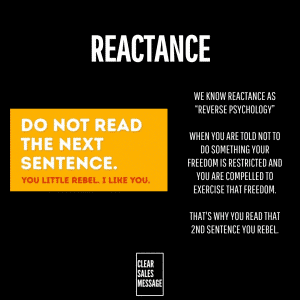
Reactance is the technical name for reverse psychology. It describes the human tendency to want something more when we are told we cannot have it, or to take an action when we are told not to. The restriction itself creates the desire.
The concept comes from psychology, where it was first studied as a response to perceived threats to personal freedom. When people feel their choices are being limited, they experience a motivational state that pushes them to reassert control. In everyday life, this shows up in everything from ignoring warning labels to buying out-of-stock products the moment they come back.
In sales and advertising, Reactance is used deliberately. A headline that tells the buyer not to buy, a gate that suggests not everyone qualifies, or a message that plays on the idea of missing out all use the same mechanism. Because the restriction feels real, the response feels genuine too.
Why Does Reactance Work?
It works because we are naturally protective of our freedom to choose. When that freedom feels threatened, even slightly, we feel a strong urge to protect it. The quickest way to protect it is to exercise it. So the buyer who is told not to click does exactly that. Not because they were persuaded. Because they were challenged.
There is also a curiosity factor. A message that tells you not to do something raises an immediate question: why not? That question creates engagement. The buyer is no longer passive. They are actively thinking about the message, which puts them in a far better state to convert than a buyer who barely registered the ad.
Reactance also works because it feels different. Most sales copy tells buyers what to do. Buy now. Sign up today. Act fast. Buyers are so used to that pattern that they have learned to filter it out. A message that breaks the pattern, one that says do not buy, do not click, this is not for you, stands out immediately. Because it is unexpected, it gets noticed.
Finally, Reactance can create a sense of exclusivity. When the message implies that the product is not for everyone, or that the buyer might not make the cut, it adds perceived value. Because something that not everyone can have feels more worth having, the buyer’s desire increases even before they know much about what is on offer.
How Can You Use Reactance In Sales?
Reactance works best when it is used with a light touch. The goal is to create a small, playful challenge that feels intriguing rather than manipulative. Heavy-handed reverse psychology feels like a trick. Subtle Reactance feels like wit.
Use It in Headlines and Ad Copy
A headline that tells the buyer not to do the thing you want them to do is the most direct application of Reactance. “Don’t read this if you are happy with your current results” or “This is not for everyone” both create immediate curiosity. Because the reader wants to know why they are being warned off, they keep reading. That is the Reactance working.
Use It to Create Exclusivity
Suggesting that your offer is not suitable for all buyers makes it feel more valuable to the ones it is for. “This only works if you are serious about growth” or “Not for businesses that are happy with the status quo” both use Reactance to filter and attract at the same time. Because the buyer wants to be in the group that qualifies, they lean towards rather than away.
Use It to Create Intrigue Around a Link or Action
Telling someone not to click a link, not to watch a video, or not to read a page creates an almost uncontrollable urge to do exactly that. Because the restriction raises the question of what is behind it, the buyer’s curiosity drives the action you wanted in the first place. Used in email campaigns, social posts, or on a webpage, this is a simple and effective Reactance trigger.
Use It Satirically in Advertising
Some of the most memorable ads use Reactance with a wink. They tell the viewer not to buy, not to try, or not to look, while making it completely clear that the opposite is true. Because the humour creates goodwill and the challenge creates engagement, satirical Reactance can cut through in a way that straight advertising rarely does.
When Reactance Works Best
Reactance works best when the buyer already has some awareness of you or your product. Cold buyers who have never heard of you may simply take the warning at face value and move on. But a warm buyer, or one who is already in your world, will recognise the playfulness and respond to the challenge.
It also works well in markets where buyers are very familiar with standard sales tactics. When every competitor is shouting buy now, a message that says do not buy stands out sharply. Because the contrast creates the attention, Reactance is most powerful in noisy or crowded spaces where the usual approach has become background noise.
Similarly, it works well for products that have strong social proof or obvious desirability. When the buyer already suspects the product is good, telling them not to buy it confirms that suspicion and adds urgency. The restriction feels like a dare rather than a warning.
When Reactance Becomes Dangerous
The risk is being taken literally. A buyer who genuinely concludes that your product is not for them, or that the warning is sincere, will walk away. So Reactance only works when the context makes the intent clear. There must be enough cues around it, tone, humour, or obvious contradiction, that the buyer understands what is really happening.
There is also a risk of it feeling manipulative. Buyers who feel they have been tricked into clicking or buying will feel resentful rather than satisfied. So the product or experience behind the Reactance hook must deliver. Because the technique raises expectations through the very act of withholding, falling short of those expectations damages trust more than a standard ad would.
Common Reactance Mistakes
Being Too Heavy-Handed
Reactance works when it feels playful and light. When the reverse psychology is too obvious or too forced, buyers see through it and feel patronised. The technique should feel like a knowing nudge, not a clumsy attempt to manipulate. So keep the tone easy and the message short. The more natural it feels, the better it lands.
Using It on Cold Audiences
Reactance works best when there is already some warmth or recognition. A cold buyer who sees “don’t buy this” may simply agree and move on. So apply Reactance to people who are already in your orbit. Warm email lists, retargeting audiences, and existing followers are all better targets than a completely cold audience seeing you for the first time.
Not Delivering on the Intrigue
When a Reactance hook gets the buyer to click, watch, or read, what they find next has to be worth it. Because the technique raised curiosity and expectation, a weak or generic landing page will feel like a let-down. So make sure the destination matches the energy of the hook. The Reactance got them there. The content has to keep them.
Overusing It
Reactance is effective because it is unexpected. When the same brand uses reverse psychology repeatedly, it stops feeling surprising and starts feeling predictable. That predictability removes the effect. So use Reactance selectively, for the moments where it will have the most impact, and rely on other approaches the rest of the time.
Reactance – An Example
There is a lot more written about Reactance, and proof that it works, if you click here.
But please don’t click that link.
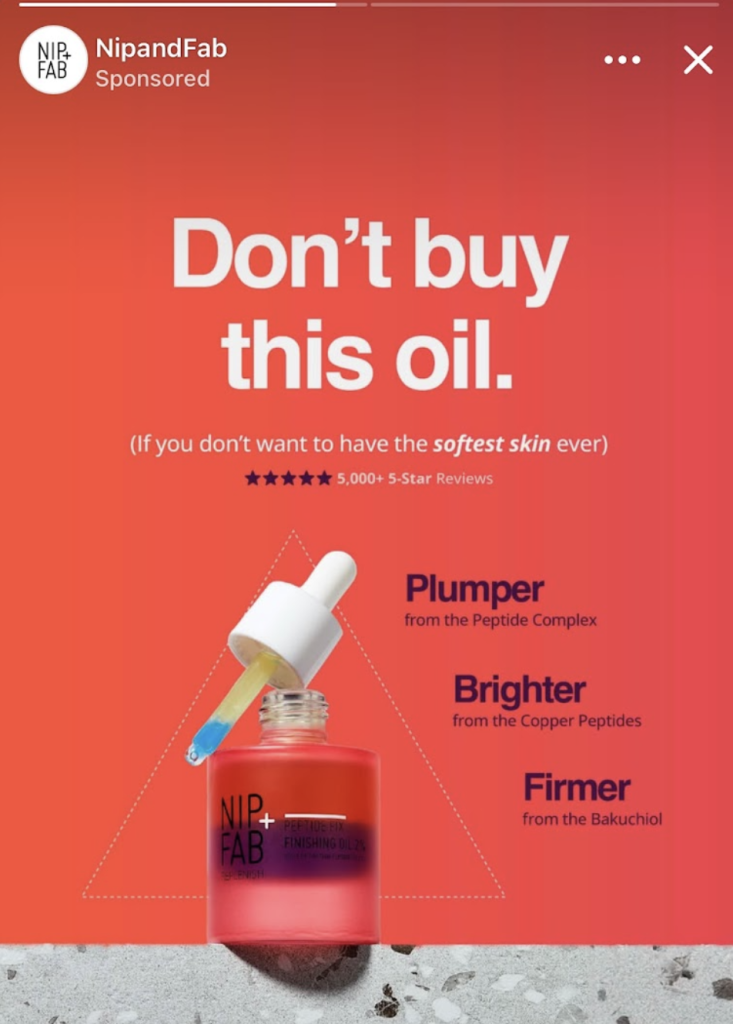
This ad uses Reactance to stop the scroll and create immediate curiosity. The headline challenges the buyer to ignore the product. Because the challenge is playful and the subtext is obvious, the buyer’s instinct is to do the opposite of what they are told. That instinct is Reactance, and it is exactly what the ad was designed to trigger.
See Also