Practical Sales Training™ > How People Work > The Local Effect

The Local Effect
What Is It?
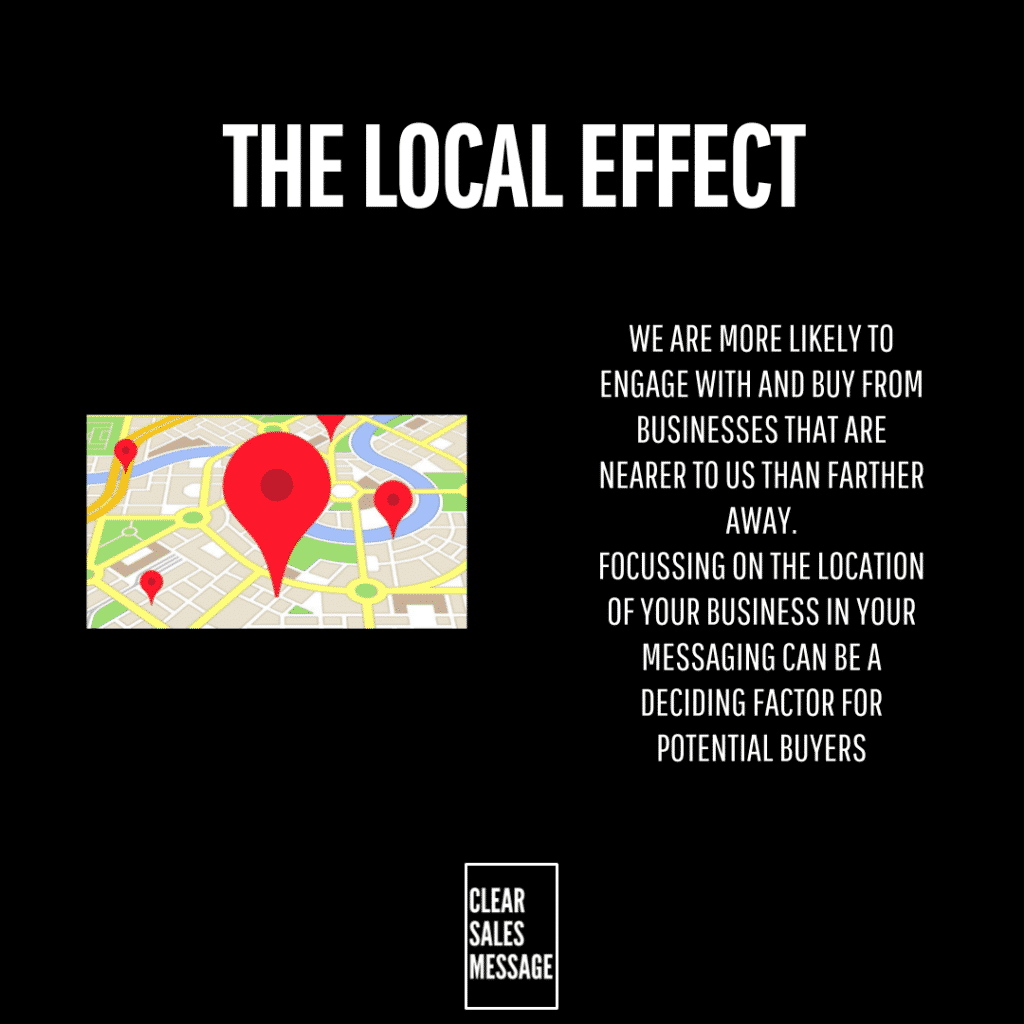
We buy from what’s near us more than what’s far away. So your location isn’t just detail, it’s a genuine deciding factor.
A buyer choosing between two similar options often picks the closer one. Not always for logic. Just because near feels safer.
Why Does It Work?
Buyers want speed and convenience. So a local supplier usually means faster delivery or less travel.
Local also implies knowledge. Because a nearby business feels like it understands the area, not just the transaction.
That feeling beats a faceless corporate alternative every time. So local isn’t just closer, it feels more trustworthy too.
How Can You Use It?
Say Where You Are
Put your location clearly in your marketing and on your site. So don’t make buyers guess or search for it. State it plainly, near the top.
Speak Directly To Locals
Name your area in your messaging. “Serving Bristol since 2015” works harder than a generic tagline. So local buyers instantly feel like you were built for them.
Go Beyond Your Address
Local isn’t only about where you’re based. So think about what you source locally too. Ingredients, materials or suppliers from the area all add to the same trust.
When It Works Best
This works best for businesses buyers can actually visit or use nearby. Shops, trades and local services all benefit here.
It also works well when speed matters. So if faster delivery or quicker service is part of your offer, your location becomes part of the pitch too.
When It Becomes Dangerous
The risk is claiming local roots you don’t actually have. Buyers check, and a fake local claim damages trust fast.
Overplaying it can backfire too. So if your product doesn’t need to be local to be good, forcing the angle just feels irrelevant.
Used honestly, this earns loyalty fast. Used loosely, it just reads as a gimmick.
Common Mistakes
Hiding Your Location
If buyers can’t find where you’re based, you lose the whole advantage. So state it clearly and early.
Overstating Local Ties
Claiming deep local roots you don’t have gets noticed fast. So only claim what’s actually true.
Forcing It Where It Doesn’t Fit
Not every offer benefits from a local angle. So use it where it’s genuinely relevant, not everywhere by default.
The Local Effect – An Example
The Farm Shop Stall
Local doesn’t always mean your own address. Sometimes it means where your ingredients or materials actually come from.
A farm shop makes this the centre of its messaging, telling customers directly that it sources from its own estate and the surrounding area wherever it can.

Each product gets named and priced individually, so the local sourcing feels specific, not vague. That specificity is what makes it believable.
Buyers feel like they’re supporting something close to home, not a distant supply chain. So the local angle becomes part of the product’s actual value, not just a marketing line.
See also
- Proximity Marketing
- Localisation
- 50+ ways that people work & make decisions
- 100+ ways to differentiate