Practical Sales Training™ > How to connect with your buyer > The Scoring Effect
The Scoring Effect
What Is It
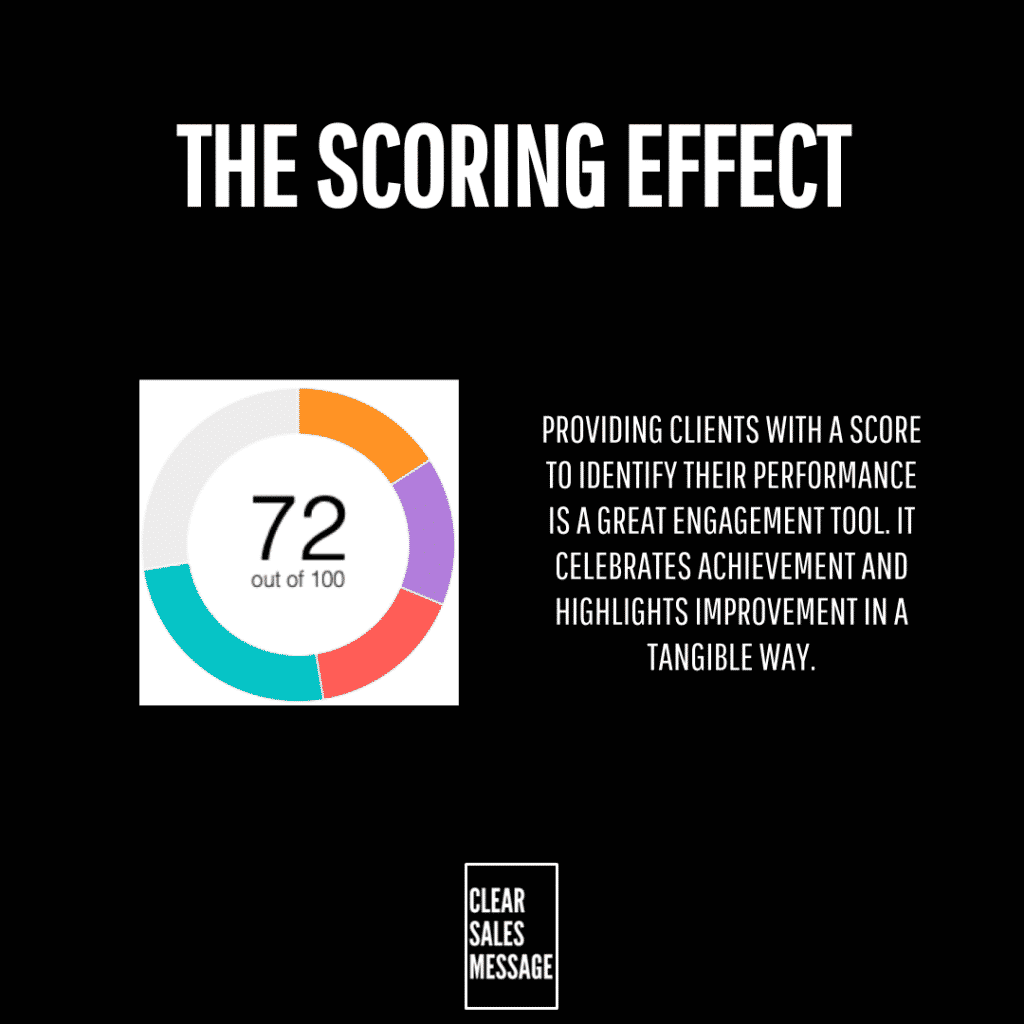
The Scoring Effect is about providing your clients with a tangible way to measure their need for your offering. A number, not just a vague sense of “you could do better.”
Most sales conversations rely on opinion. This effect replaces opinion with something that looks and feels objective.
A score gives a buyer something concrete to react to, agree with, or want to improve.
Why Does It Work
It works because we’re human beings who are competitive, curious, and always seeking outside measurement and approval to understand where we stand in life, love, and work.
By providing a scoring mechanism to potential clients, you tap into these competitive behaviours. You also display confidence, certainty and expertise, since you’re the expert grading the client and advising on improvement.
There’s an authority shift happening too. The buyer stops being the one deciding whether they need help. Your score decides that for them, and they respond to it.
How Can You Use It
Build a simple, real scoring system
Depending on your offering, can you provide your clients with a simple set of questions and a score out of 25, 50, or 100, to measure their current position and advise on how it might improve? LinkedIn use the SSI score as a way of grading performance on LinkedIn and understanding what to improve.
Show the buyer where they stand, then how to move
How could you help your clients rate themselves, understand where they are now, and see how to improve? That combination inspires confidence that you’re the one who can actually help them.
Turn the score into a repeatable lead magnet
A good scoring tool doesn’t just work once. Build it so it can run in ads, DMs, or emails repeatedly, generating fresh leads long after you’ve built it.
When It Works Best
This works best when there’s a genuine, checkable gap between where a buyer is and where they could be, something a few clear questions can actually measure.
It also works best when the score leads naturally to your offering, rather than feeling like an unrelated quiz bolted onto a sales pitch.
When It Becomes Dangerous
It backfires if the scoring feels rigged toward a low result, purely to manufacture a problem. Buyers who sense that lose trust in the whole exercise.
It also becomes risky if the questions are too vague to feel objective. A scoring tool only works if the buyer believes the number genuinely reflects something real.
Overpromising the fix afterward causes its own damage. A confident score followed by a solution that doesn’t deliver undoes the credibility the tool just built.
Common Mistakes
Making the questions too vague to feel credible
Fuzzy questions produce a fuzzy score, and buyers can tell. Specific, checkable questions make the whole tool feel trustworthy.
Skewing the score to always look bad
If every result comes back low regardless of the answers, buyers eventually notice the pattern and stop trusting the score entirely.
Giving a score with no clear next step
A number alone doesn’t sell anything. Pair every score with a specific, obvious action the buyer can take to improve it.
The Scoring Effect – An Example
A Website Conversion Score
You have a “Website Conversion Score” tool that grades websites on key conversion factors. Clients answer 8 to 10 simple questions such as:
- Is your call-to-action visible on every page?
- Do you have a compelling headline above the fold?
- Is your site mobile-optimised?
- How fast does your site load?
- Do you use trust signals (testimonials, badges, reviews)?
- Do you track conversion rates?
Each question is worth 10 points, with a maximum score of 100.
Score Tiers:
- 0-40: Underperforming – your website is likely losing leads
- 41-70: Functional – some key components are in place but inconsistent
- 71-100: High-performing – your site is geared to convert traffic into customers
Follow-up Example:
“Your score: 38. You’re missing vital conversion elements and likely leaving money on the table. With our Conversion Clarity Package, we can fix this and boost your leads within 30 days.”
This approach gives a clear, objective measurement, builds urgency, and naturally positions your service as the fix. It also creates a repeatable lead magnet you can use in ads, DMs, or email.
See also