
Practical Sales Training™ > How To Get Attention > The Ambiguity Effect

The Ambiguity Effect
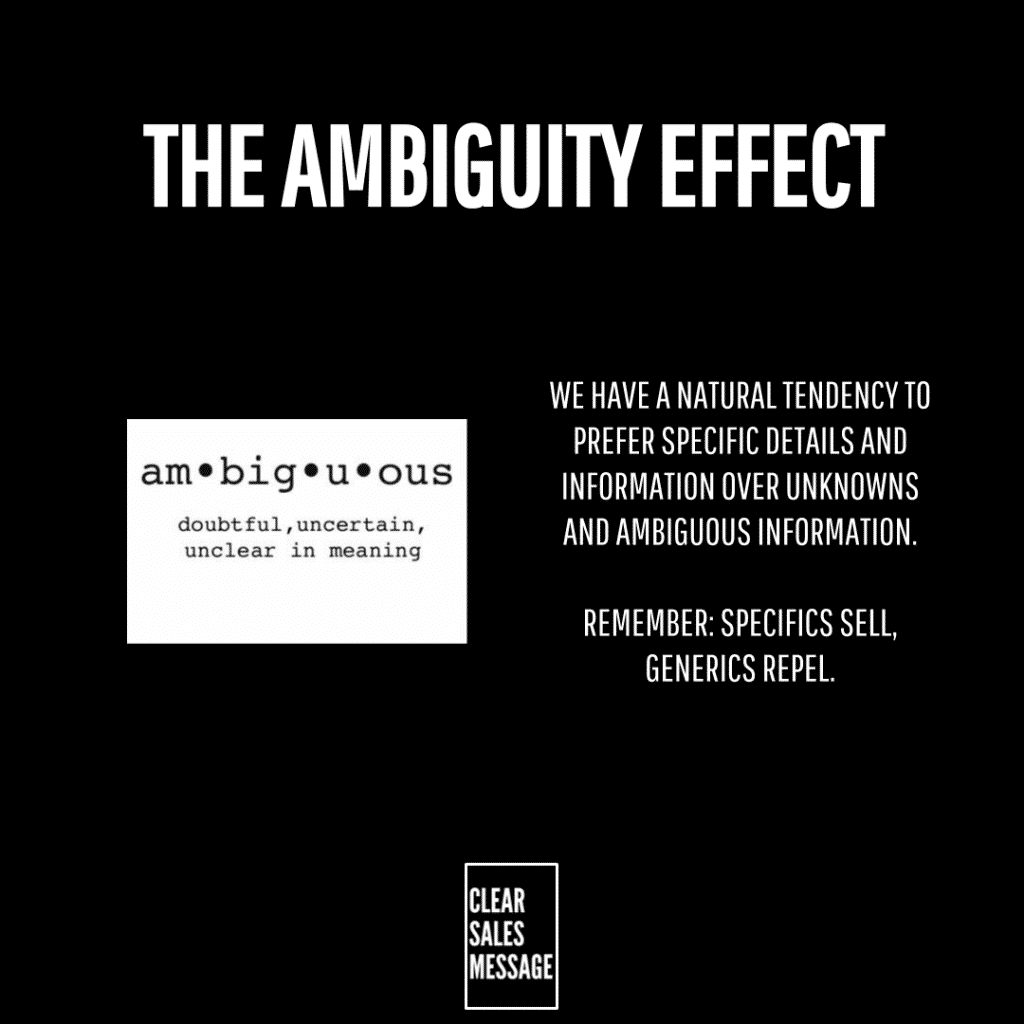
Two offers. Same price. One is vague, one is specific. Buyers choose the specific one almost every time. That is the Ambiguity Effect.
We do not like uncertainty. When an offer is unclear or hard to define, we pull back. We worry about what we might not know. And we look for something that feels safer, more defined, and more certain.
The Ambiguity Effect describes our preference for specific, defined information over vague and unknown alternatives. In sales, being precise is one of the easiest ways to make your offer more appealing.
What Is The Ambiguity Effect?
When a buyer evaluates an offer, they try to answer one question: do I know what I am getting? If yes, the decision feels safe. When it is not, doubt creeps in. Because doubt is uncomfortable, buyers avoid what causes it and move towards what feels clear.
A specialist always feels safer than a generalist – a boiler repair specialist over a general plumber, an Audi specialist over a general garage. Not because the specialist is always better, but because the choice feels less risky. Choosing a specialist means knowing what you are getting. A generalist does not give you that.
The Ambiguity Effect is also linked to Zero Risk Bias. Because we fear the unknown, we often pay more for an inferior option simply because it feels more defined. Certainty has real value to buyers, even when it is just certainty of understanding.
Why Does The Ambiguity Effect Work?
Buyers are always looking for confidence, certainty, and expertise. When something looks vague or undefined, it signals risk. When it looks specific and precise, the risk signal drops. That shift happens fast, often before the buyer has read past the headline.
Because vague language creates gaps, buyers fill them with assumptions – and not always favourable ones. A specific claim leaves fewer gaps. The buyer knows what they are getting, what the result looks like, and what they can expect. That knowledge removes the hesitation that vagueness creates.
There is also a memorability factor. Specifics stick. “We helped 200 businesses” stays in the mind longer than “we help businesses grow.” Because the number is concrete, the brain can hold onto it. So specific claims do not just convert better in the moment – they also stay with the buyer after the conversation.
How Can You Use The Ambiguity Effect?
Look at every piece of copy, every claim, and every offer you make. Where are you being vague when you could be specific? Numbers, dates, facts, and named outcomes all reduce ambiguity. Each one makes your offer easier to trust and easier to choose.
Use Numbers Wherever You Can
Replace vague claims with specific ones. Instead of we get results, use: we have helped over 200 businesses increase their close rate in 90 days. Rather than we save you money, say: our clients save an average of 14 hours a week. Because a specific number is harder to dismiss than a vague claim, it builds more trust.
Be Specific in Your Naming and Titles
We titled our book How To Write a Tagline: 74 Ready to Use Templates and Ideas. Called The Tagline Bible or The Tagline Book, a buyer would be less sure of what to expect. That uncertainty alone could stop a purchase, however good the book actually is.
Remember This Rule
Specifics sell. Generics repel. The more precise your offer, the less work a buyer has to do. And the less work they have to do, the more likely they are to choose you.
When The Ambiguity Effect Works Best
The Ambiguity Effect works best when buyers choose between two offers that both seem reasonable. At that point, the more specific offer wins because it feels more certain. A buyer can justify choosing it. They can point to the number, the fact, and the clear outcome. Choosing feels safer.
It also works well when your offer is complex or unfamiliar. The less a buyer knows about your sector, the more uncertain they feel. Specifics bridge that gap. Precise answers to questions buyers fear asking remove the vagueness that might stop them.
It is also particularly effective when you operate in a crowded market. When many businesses offer a similar service, the one that speaks with the most precision stands out. Vague competitors make your specificity even more visible by contrast.
When The Ambiguity Effect Becomes Dangerous
The main risk is making claims you cannot back up. A specific number that turns out to be wrong destroys trust faster than any vague claim. Every specific you use must be true and checkable. Because specificity raises expectations, you must also be able to meet them.
There is also a risk of using specifics in the wrong context. In creative work, naming, and some brand communications, ambiguity is a tool rather than a flaw. The Ambiguity Effect tells you to be specific in your sales claims. It does not tell you to replace every piece of writing with a number and a bullet list.
Common Ambiguity Effect Mistakes
Using Vague Claims Out of Habit
The most common mistake is falling back on vague language because it feels safe. Replace the habit with a rule: if you can add a number, add it. Compare these to their specific alternatives:
We help businesses grow.
We deliver great results.
We provide excellent service.
Each sounds fine until you see a specific version beside it.
Using Specifics Without Context
A second mistake is using specifics without context. That 94% client retention rate sounds impressive, but buyers need to know what the benchmark is to appreciate it. Give the number and the frame. Show what makes it meaningful.
Assuming Buyers Will Fill the Gaps
A third mistake is leaving ambiguity in place and hoping buyers will imagine the best. They will not. They will imagine the worst, or stop imagining altogether and move to the next option. Spell it out. The buyer who is not confused is the buyer who converts.
The Ambiguity Effect – An Example
A financial adviser could say: we help people save money for the future (vague and generic). Or they could say: we help families save £1,200 a year on bills. We also grow their retirement fund by 8% annually (specific and tangible).
Both say the same thing in principle. But the second removes the ambiguity that makes the first forgettable. Buyers can picture the outcome and say yes to it.
Specifics sell. Generics repel.
See Also