
Practical Sales Training™ > How To Connect With Your Buyer > The Because Effect

The Because Effect
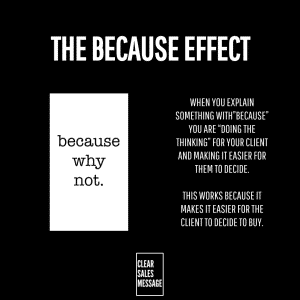
Buyers do not just want to be told what to buy. They want to understand why. The Because Effect gives them that. It does the thinking for them, pre-emptively answering the question they were about to ask.
One word does a lot of work here. Because signals that a reason is coming. It tells the reader to pay attention. And because the reason follows naturally from the problem, the conclusion feels obvious rather than argued.
The Because Effect is the practice of using the word because to present the reasoning behind a buying decision. The buyer can then adopt that thinking without working it out themselves.
What Is The Because Effect?
Buyers take shortcuts. When reasoning is already laid out for them, they tend to accept it rather than question it. This is not about manipulation. It is about making the decision easier. Because the thinking is already done, the buyer simply agrees with it rather than builds it from scratch.
There is also a trust element. When you explain why your offer is the right choice, you demonstrate that you understand the buyer’s situation. When you diagnose the problem and link it to the solution, the buyer feels guided rather than sold to.
This also works because it links cause and effect in the buyer’s mind. The problem exists, therefore the solution makes sense. When that link is clear and natural, the buyer does not need to ask whether your offer applies.
Why Does The Because Effect Work?
Research into persuasion has consistently shown that giving a reason, any reason, increases compliance. The word because acts as a trigger. It tells the listener that a justification is coming, and they prepare to receive it. Because that preparation makes them more open, the reason lands more effectively than it would without the word.
It also mirrors how we naturally justify our own decisions. When we choose something, we explain it to ourselves with because. So when you use because in your copy, you are helping the buyer complete the sentence they were already trying to finish. Because my back hurts and I need to sit properly, I should buy the better chair. You just helped them get there faster.
There is also an ease-of-thinking effect. Forming a decision from scratch takes mental energy. Following a logical path already laid out takes much less. Because most buyers are not actively looking for a reason to resist, a clear and well-placed because gives them everything they need to say yes.
How Can You Use The Because Effect?
Use it in your FAQs. When a buyer has a question, the because construction lets you answer and justify it in a single line. Not just yes, but yes, because. That structure is more reassuring and more useful than a bare answer.
Handle Objections Before They Arise
Think about the main doubts a buyer might have and write a because sentence for each one. The price feels high? State the price and add because this is handmade to order and takes four hours to produce. The lead time feels long? State it and add because we do not hold stock we do not need. Because turns the potential objection into evidence of quality.
Use It Across Your Copy
On your homepage, in your emails, in your proposals. Because is one of the hardest-working words in sales writing. It moves the buyer from what to why, and why is almost always the more persuasive conversation. Use it wherever a buyer is likely to hesitate and wonder why.
When The Because Effect Works Best
The Because Effect works best when the reason it gives is genuinely compelling. A weak because is worse than no because at all. If the reason does not justify the conclusion, the buyer will notice. The trust you were building will dissolve. So only use because when you have a real reason to offer.
It also works well when the buyer is in evaluation mode. When comparing options and looking for reasons to choose, a clear because gives buyers the argument they need. Because the case is already made, they do not need to make it themselves.
It is also effective in longer-form content like proposals and case studies. When you are walking a buyer through a recommendation, because keeps the logic visible and connected. Each because makes the next step feel inevitable rather than imposed.
When The Because Effect Becomes Dangerous
The main risk is overusing it. When every sentence contains because, the technique becomes visible and the natural feel is lost. Use it where it matters most, at the points where a buyer is most likely to hesitate or question. Because is more powerful when it is occasional and well-placed.
There is also a risk of using it to justify something unjustifiable. Because I said so is not a reason. Nor is because our process requires it. That reason needs to serve the buyer, not explain away a flaw in your offering.
Common Because Effect Mistakes
Writing Because Statements That Serve the Seller
The most common mistake is writing because statements that serve the seller rather than the buyer. Compare these two:
Because we need four weeks to process your order. (serves the seller)
Because we take four weeks to hand-build every unit to your exact specification. (serves the buyer)
Same fact. Very different framing. Always point the reason in the buyer’s direction.
Placing Because in the Wrong Position
A second mistake is placing because in the wrong position. The most powerful version often starts with the problem, then bridges with because to the solution. Starting with the solution and adding because as an afterthought weakens the structure. Lead with the situation the buyer is in, then use because to connect it to the answer.
Using a Weak or Obvious Reason
A third mistake is using because with a reason so weak or obvious that it adds no value. Because it’s a great product is not a reason. Because it reduces your monthly admin by three hours is a reason. The strength of the because depends entirely on the strength of what follows it.
The Because Effect – An Example
A meal delivery service writes: most people struggle to eat healthily because they have no time to plan meals. That is why we send you chef-prepared, healthy meals, because your time is better spent enjoying life, not cooking.
The first because names the obstacle. Its second because frames the solution. Together, they take the buyer from their daily problem to your offer in two sentences. Because the logic is clear and the benefit is obvious, the buyer needs no convincing. They just need to say yes.
That is the Because Effect. Not a hard sell. A clear reason. And a clear reason is almost always more persuasive than a clever pitch.
See Also
- Frequently Asked Questions
- Troubleshooting
- 150+ ways to connect with your buyer
- 100+ ways to get your buyer to take action