
Practical Sales Training™ > How To Get Attention > The Ethical Advantage

The Ethical Advantage
People are paying more attention to the businesses they support. They want to know how you treat your staff, where your materials come from, and whether you give back. These things used to be nice extras. Now they can decide the sale.
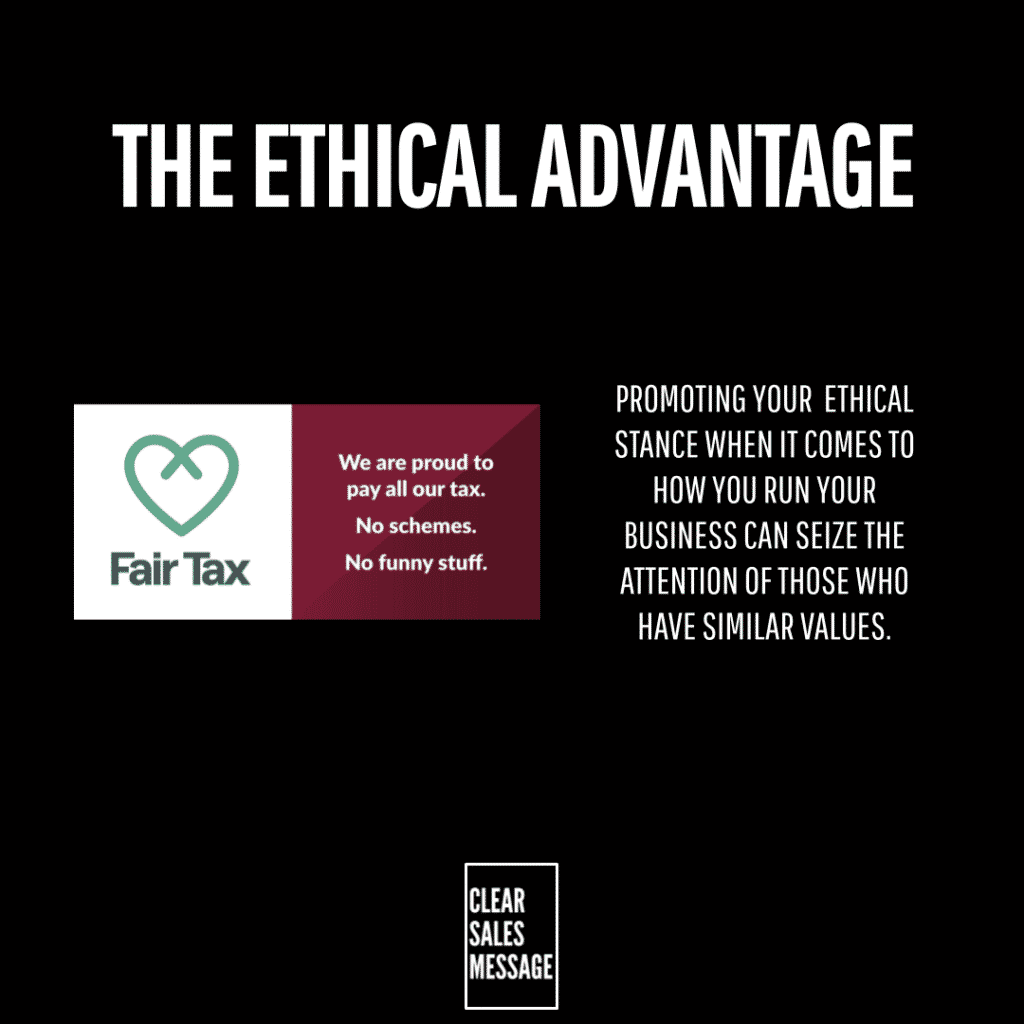
The Ethical Advantage is about making your responsible behaviour visible. This is not a PR stunt. It is a genuine part of who you are and how you trade. When buyers share your values, they choose you. And they tell others.
Most businesses either fail to behave responsibly, or they do the right thing and never mention it. Either way, there is a gap. Step into it and you create an unfair advantage that rivals find very hard to copy.
What Is The Ethical Advantage?
The Ethical Advantage is the benefit of being responsible and making that visible in your identity and your message. This goes beyond having good values. It means building those values into how you show up in the market.
Buyers today have more choice than ever and more ways to research who they buy from. Reviews, social media, and supply chain data give buyers a view of a business that goes well beyond the product. So how you operate is now part of what you sell.
When your ethics are genuine and visible, they attract buyers who share those values. These buyers tend to be more loyal, more likely to refer others, and less likely to leave on price alone. That is a very different kind of customer from one who simply chose the cheapest option.
Why Does The Ethical Advantage Work?
It works because most businesses are either not behaving responsibly or are failing to talk about it. That means the bar is low. Even modest, genuine ethical action stands out in a market where buyers are actively looking for it.
It also works because values are hard to replicate quickly. A rival can match your price or copy your product features. But a culture of ethical trading, built over time and backed by real action, takes years to build. So the advantage compounds the longer you invest in it.
There is also a trust dimension. Buyers who believe you are doing the right thing extend more goodwill to you when things go wrong. They are more patient, more forgiving, and more willing to stay. So The Ethical Advantage is not just a marketing tool. It is a relationship asset.
How Can You Use The Ethical Advantage In Sales?
Audit what you already do
Start by looking at what your business already does responsibly. Think about your suppliers, your team, your green credentials, and whether you donate to a cause. Many businesses are already doing things worth talking about. They just never think to mention them.
Make it part of your identity, not an afterthought
The Ethical Advantage only works if it is genuine and consistent. Buyers tell the difference between a business that trades responsibly and one that bolted on an ethical story. Make it real. Weave your values into your brand, your language, and your behaviour, not just a page on your website.
Say it simply and say it clearly
Most businesses that do act ethically undersell it because they talk about it in vague or corporate terms. Instead, be specific and direct. “We are committed to sustainability” says nothing. “Our packaging is fully compostable” does. Make the swap and your claims land.
Use it to attract the right buyers
Not every buyer will care about your ethics. But some will care deeply, and these are often the buyers worth having. They align with your values, they stay longer, and they recommend you to people like them. Use it to win sales and to attract the clients you actually want.
When The Ethical Advantage Works Best
It works best in crowded markets where products and prices look similar. When buyers cannot easily differentiate on features, they look for other reasons to choose. Ethics can be that reason. If two offers are roughly equivalent, the one backed by values often wins.
It also works well when your buyer is a person, not just a business. Consumer buyers are more likely to factor values into their decisions than procurement teams working from a spec sheet. But even in B2B, individual buyers bring their personal values to the table. So never assume ethics do not matter in business-to-business sales.
And it works particularly well over time. The first buyer who chooses you because of your ethics might tell three others. Those three might each tell three more. The Ethical Advantage has a compounding effect that most other sales levers do not.
When The Ethical Advantage Becomes Dangerous
The biggest risk is greenwashing or ethics-washing: claiming values you do not hold or actions you do not take. Buyers have become very good at spotting the gap between what a business says and what it does. If the story does not hold up to scrutiny, the backlash is far worse than saying nothing.
There is also a risk of inconsistency. If you talk about looking after your team but your staff reviews tell a different story, the gap damages trust. Check that your operations back it up at every point a buyer might look before you lead with it.
Finally, do not assume all buyers care equally. Leading with ethics when a buyer only cares about price and delivery can make you sound out of touch. Read the room and bring it up when it is relevant, not as a default opener.
Common Ethical Advantage Mistakes
Being vague instead of specific
Phrases like “committed to sustainability” or “we care about our community” say nothing. Every competitor can say the same. So replace vague language with specific facts. How much do you give? What has actually changed because of your actions? Specifics build credibility. Generalities do not.
Treating it as a marketing add-on
If ethics only appear on your website and not in how you actually trade, buyers will see through it quickly. You earn The Ethical Advantage through behaviour, not through copy. So start with the actions and let the messaging follow, rather than the other way around.
Never mentioning it at all
Many ethical businesses never mention it because they worry about sounding self-congratulatory. But buyers cannot value what they do not know. So if you are doing the right thing, say so. Frame it as useful information for the buyer, not a boast, and let them decide whether it matters to them.
The Ethical Advantage – An Example
The coffee brand that made its values the product
A coffee brand competes in a crowded market where price and taste are often the only things that differ. Instead of fighting on those terms, it leads with its responsible practices. It sources beans from fair-trade farms only. Its packaging is fully compostable. And it donates five percent of profits to fund education in coffee-growing communities.
The messaging is clear and specific. “Every cup you drink funds a child’s education.” Buyers who share those values do not just buy the coffee. They buy into the purpose. As a result, loyalty goes up and word-of-mouth does a large part of the marketing. The product is good. But the values are what make it easy to choose and easy to recommend.
See Also
- The ECO Effect
- Core Values
- The Workforce Effect
- 100+ ways to seize buyer attention
- 100+ ways to differentiate