
Practical Sales Training™ > How To Get Attention > The Special Edition Effect

The Special Edition Effect
What Is It
The Special Edition Effect is all about taking your offering and tailoring it to make it unique and special in some way. Not a discount. A genuinely different version.
It works on scarcity and identity at once. A special edition isn’t just rarer. It’s built for someone specific.
That combination makes people pay attention to something they might otherwise scroll straight past.
Why Does It Work
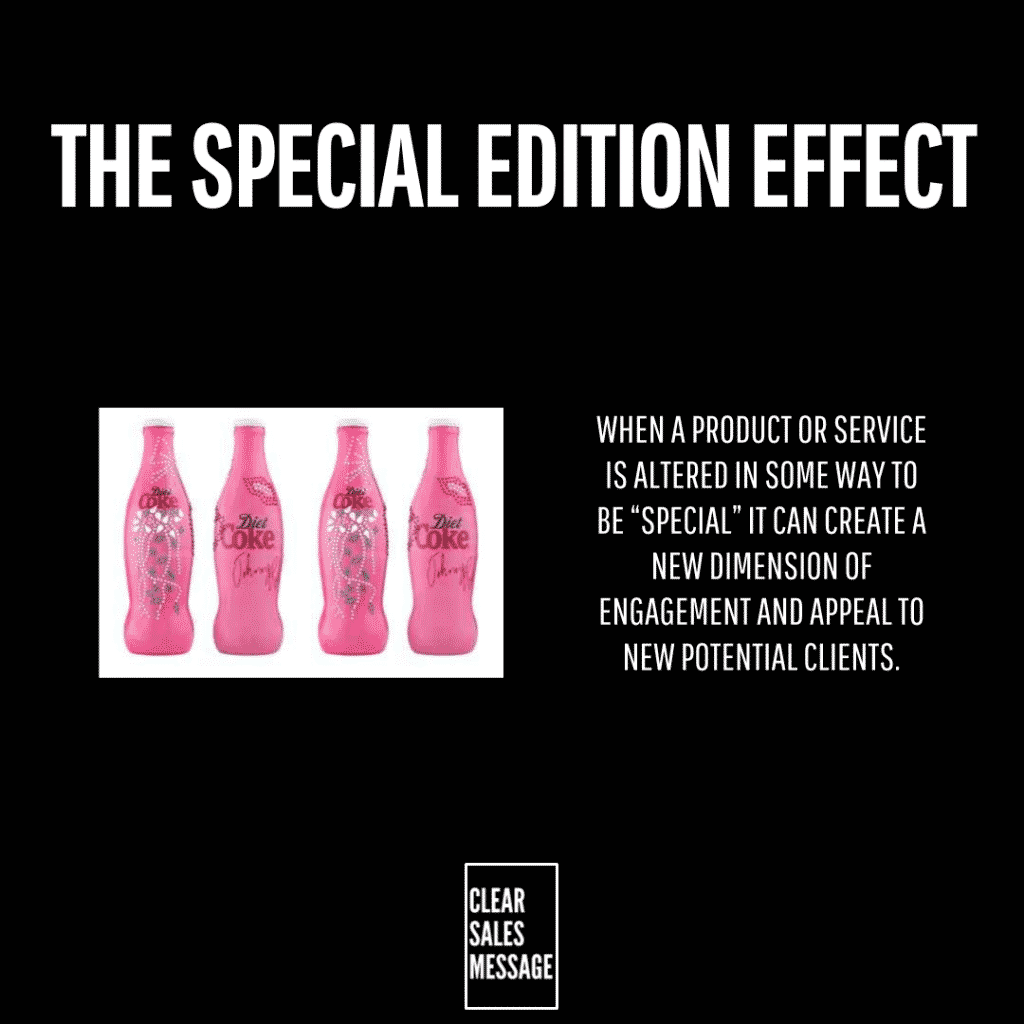
It works because as humans we appreciate novelty. We find it easier to relate to very specific offerings that appeal to very specific people or needs. Combining brands, as Coke do in the photo, also creates a degree of novelty. It lets the product stand out by using The Bizarreness Effect.
A generic product speaks to everyone a little. A special edition speaks to someone specific, loudly.
That specificity is what makes it memorable. Buyers remember the thing that felt made for them far longer than the thing that felt made for anyone.
How Can You Use It
Build around a specific buyer or need
Can you create a special version of your offering to appeal to a certain type of buyer? Could you create a special version that appeals to a certain type of need? Both approaches narrow your audience on purpose. That narrowing is what makes the edition feel special in the first place.
Tie it to a niche or a collaboration
Could you create a special version related to a particular niche in your marketplace? Could you co-brand with another company to create a special edition offering? A genuine collaboration adds novelty that a solo release rarely can on its own.
Mark it with the moment it belongs to
Create an edition for the year you’re in, to communicate newness, “2024 Edition” or “2026 Edition.” A dated edition signals freshness. It also signals a natural point where it might disappear.
When It Works Best
This works best when the special version is genuinely different, not just relabelled. It also works best when the audience it targets is narrow enough to feel personally addressed.
It works best with a real, credible limit too. A number, a date, or a collaboration that can’t simply be repeated whenever you like.
When It Becomes Dangerous
It backfires if the “special” version is barely different from the standard one. Buyers who feel misled rarely trust the next special edition you release.
It also becomes risky if you release too many special editions too often. The word “special” stops meaning anything once it appears on every single product.
Overpricing a special edition beyond what the novelty justifies causes its own damage. Buyers can tell the difference between rarity and a markup.
Common Mistakes
Making the difference purely cosmetic
A new colour with nothing else changed rarely justifies the word “special.” The edition needs a genuine reason to exist beyond appearance.
Releasing special editions too frequently
If a new “limited edition” drops every month, none of them feel limited anymore. Space them out enough that each one still means something.
Targeting nobody in particular
A special edition aimed at “everyone” isn’t really special. Narrow the audience deliberately, even if it feels counterintuitive.
The Special Edition Effect – An Example
Rolls Royce’s Boat Tail
Car manufacturers often release special editions. Rolls Royce are particularly good at this. They release very low numbers of limited edition models, such as the Boat Tail, a 1 of 1.
A single unit isn’t just rare. It’s unrepeatable. That absolute scarcity does more for desirability than any marketing copy ever could on its own.

See also
- The Signature Effect
- The Themed Sale Effect
- 100+ ways to seize buyer attention
- 100+ ways to be more memorable