
Practical Sales Training™ > How People Work > The Zeigarnik Effect

The Zeigarnik Effect
What Is It
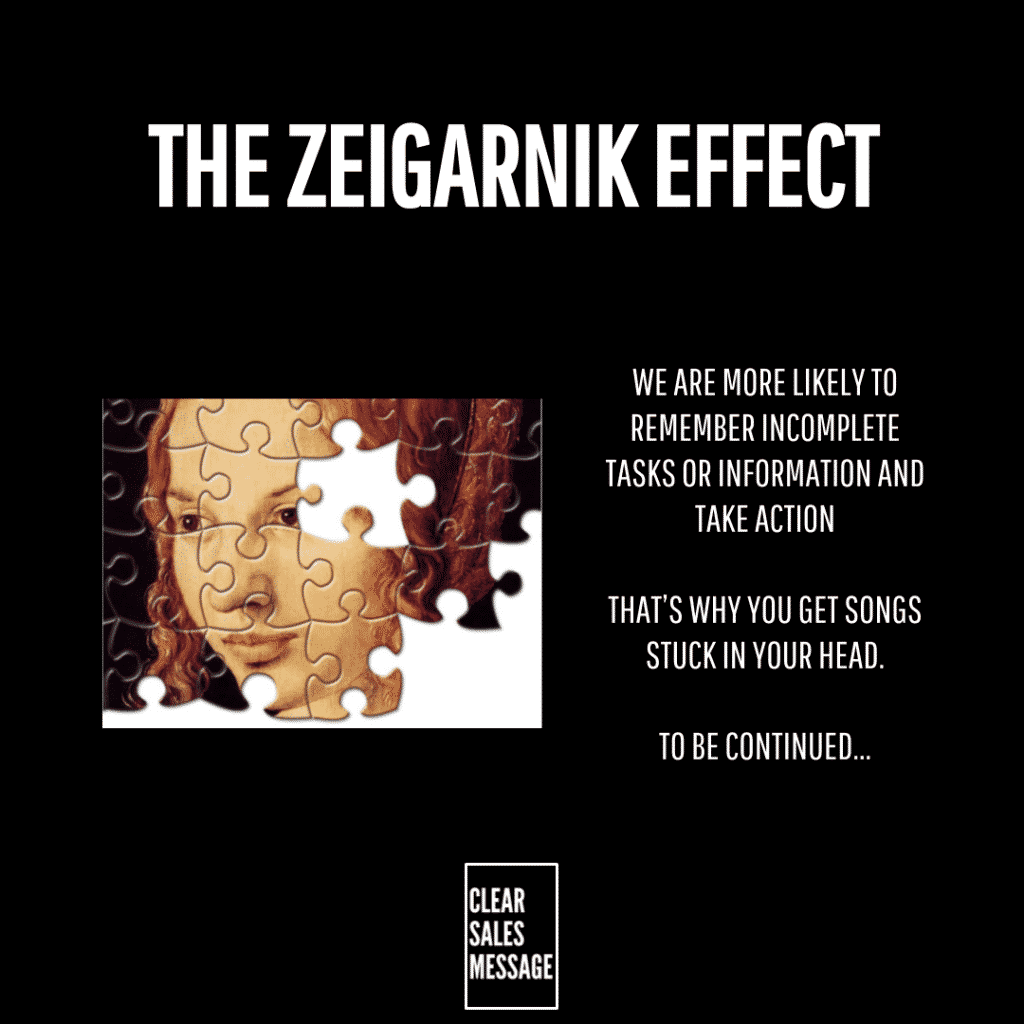
If you’ve ever had a song stuck in your head for the day. And weren’t sure why. You’ve experienced the Zeigarnik Effect.
We’re more likely to remember uncompleted or interrupted tasks than completed ones. You only heard part of that song, so it’s incomplete, and it stays in mind. You feel an urge to hear it in full.
Why Does It Work
It works because our minds are literally wired to recall incomplete things. This also explains how waiters can recall the orders for tables they’re serving. Once the party leaves, they forget much of what was ordered.
How Can You Use It
The Zeigarnik Effect can be used to create intrigue and engagement in clients, much like using information gaps.
How could you allude to your product or service, and present some of the information around your offering? Could you stagger what you present, to build desire and intrigue over time?
When It Works Best
This works best on multi part content, courses, series, or anything with a genuine next step still to come.
It also works best when the missing piece feels genuinely valuable, not just withheld for the sake of it. A buyer needs to feel there’s real substance still to come.
When It Becomes Dangerous
It backfires if the incomplete information feels like a deliberate withholding trick. Buyers can sense when something’s held back purely to manipulate them.
It also becomes risky if you never actually deliver the promised conclusion. A buyer left hanging permanently just feels cheated, not intrigued.
Overusing cliffhangers across every piece of content wears the technique thin. Eventually buyers stop trusting there’s a real payoff at all.
Common Mistakes
Withholding information with nothing valuable behind it
Withholding information with nothing genuinely valuable behind it just frustrates buyers rather than intriguing them.
Failing to deliver the promised conclusion
Failing to deliver the promised conclusion at all leaves buyers feeling cheated rather than satisfied.
Using this technique too often
Using this technique in every single piece of content trains buyers to expect a trick, not a genuine reveal.
The Zeigarnik Effect – An Example
A Free Video Series On Sales Techniques
Hypothetical Example: A course creator launches a free video series about improving sales techniques. In the first video, they say:
“There are 5 powerful steps to closing more deals. Today, I’ll share the first 3, and the last 2 are what make everything really work.”
Viewers are left with a sense of incompleteness. They know there’s more to learn, and feel compelled to sign up for the full course. They want to discover the remaining steps.
This works because the incomplete information triggers the Zeigarnik Effect. It keeps the content front of mind, and motivates buyers to seek closure.
See also