
Practical Sales Training™ > How To Convert > The Cash Back Effect

The Cash Back Effect
Discounts work, but they come with a cost. Once a price drops, buyers start to wonder what the product is actually worth.
So a cashback offer gets around that. It rewards the buyer just as much, but the price tag never moves.
Same psychological win. Different perception entirely.
What Is The Cash Back Effect?
The Cash Back Effect is an alternative to discounting. Offering cash back has the same effect, but without associating the offering with a “lower” price.
The product stays positioned at full value, while the buyer still walks away feeling rewarded for their purchase.
Why Does The Cash Back Effect Work?
It works because it encourages the buyer to buy in the same way a discount would. They get a great deal on something they need, but it doesn’t affect how the price of the offering is perceived, which makes everyone feel better.
Discounting can make an offering feel cheaper and affect how its value is perceived. So offering cash back avoids this entirely, while still achieving the same overall objective.
How Can You Use The Cash Back Effect In Sales?
Decide on the amount
Depending on your offering, think about how you could offer cash back and how much it might be. This works best for physical products, but it can apply to almost anything you sell.
Set the terms clearly
Will you offer £50, £100, or £500 cash back? Over what time period? How should your buyer claim it? Being clear on the details, and any qualifying criteria, is essential to success.
Make the claim process simple
If claiming the cashback feels complicated or time consuming, buyers won’t bother, which undermines the whole offer. So keep the process as easy as possible.
When The Cash Back Effect Works Best
It works best on higher value, premium products, since protecting the price perception matters far more when the buyer is paying a significant amount.
It also works well when you want to reward buyers without setting a precedent of lower prices, because once a discount happens once, buyers often expect it again.
When The Cash Back Effect Becomes Dangerous
It becomes dangerous if the claim process is so awkward that buyers feel misled. A cashback offer that’s hard to redeem can feel like a trick rather than a genuine reward.
It can also backfire if the terms aren’t communicated clearly upfront, since confused or frustrated buyers are unlikely to trust your next promotion either.
Common Cash Back Effect Mistakes
Making the claim process too complicated
If buyers have to jump through hoops to get their cashback, many simply won’t bother. So keep the steps short and obvious.
Hiding the qualifying criteria
Buried terms create frustration and damage trust. So be upfront about exactly what someone needs to do to qualify.
Setting the amount too low to matter
A token cashback amount barely registers as a reward. So make sure the figure feels worth the effort of claiming it.
The Cash Back Effect – An Example
A smartphone retailer’s £100 cashback promotion
A smartphone retailer launches a new promotion: “Buy the latest Galaxy Ultra for £999 and claim £100 cashback within 30 days of purchase!”
Here, the phone is still positioned as a premium £999 product, but the £100 cashback gives buyers the same psychological reward as a discount. So the price perception stays high, and the customer feels like they’re getting a bonus, rather than buying something “on sale.”

10 alternative ways to discount your offering:
- First purchase– Discount the first purchase a buyer makes with you.
- Follow up offer – Follow up those who didn’t buy with an incentive.
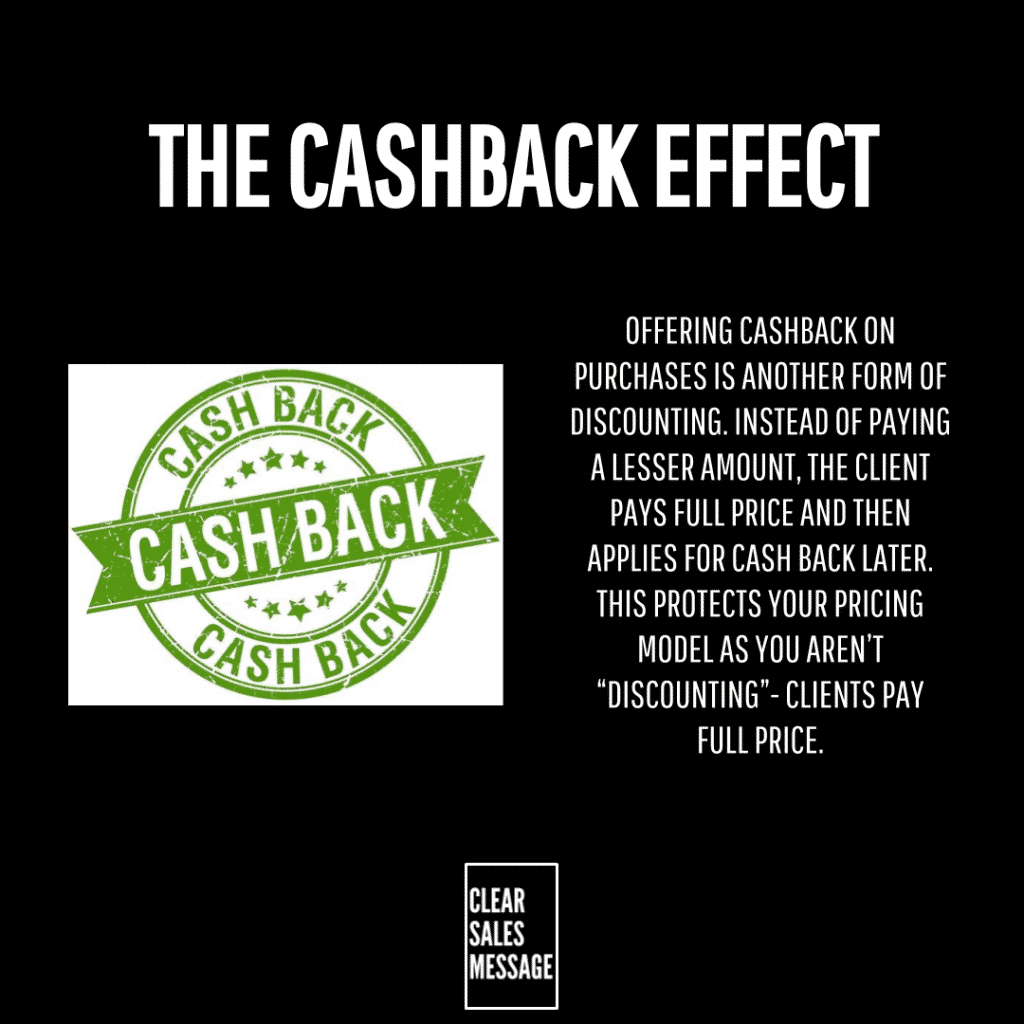
- Cashback – Don’t discount, but provide cash back to those who pay full price.
- Themed Sale – Create an event or reason to hold a sale.
- Price Match – Offer to match the genuine price of a competitor.
- Buy more – Incentivise buyers to spend more with ascending discounts.
- Free gift- Offer a free gift with purchase.
- Early bird – Offer a discount for those who buy/pay in advance.
- Flash Sale – Hold a flash sale
- Budget version -create a naturally cheaper version of your offering to appeal to lower spending buyers.
