
Practical Sales Training™ > How to connect with your buyer > Ascending Number List

Ascending Number List
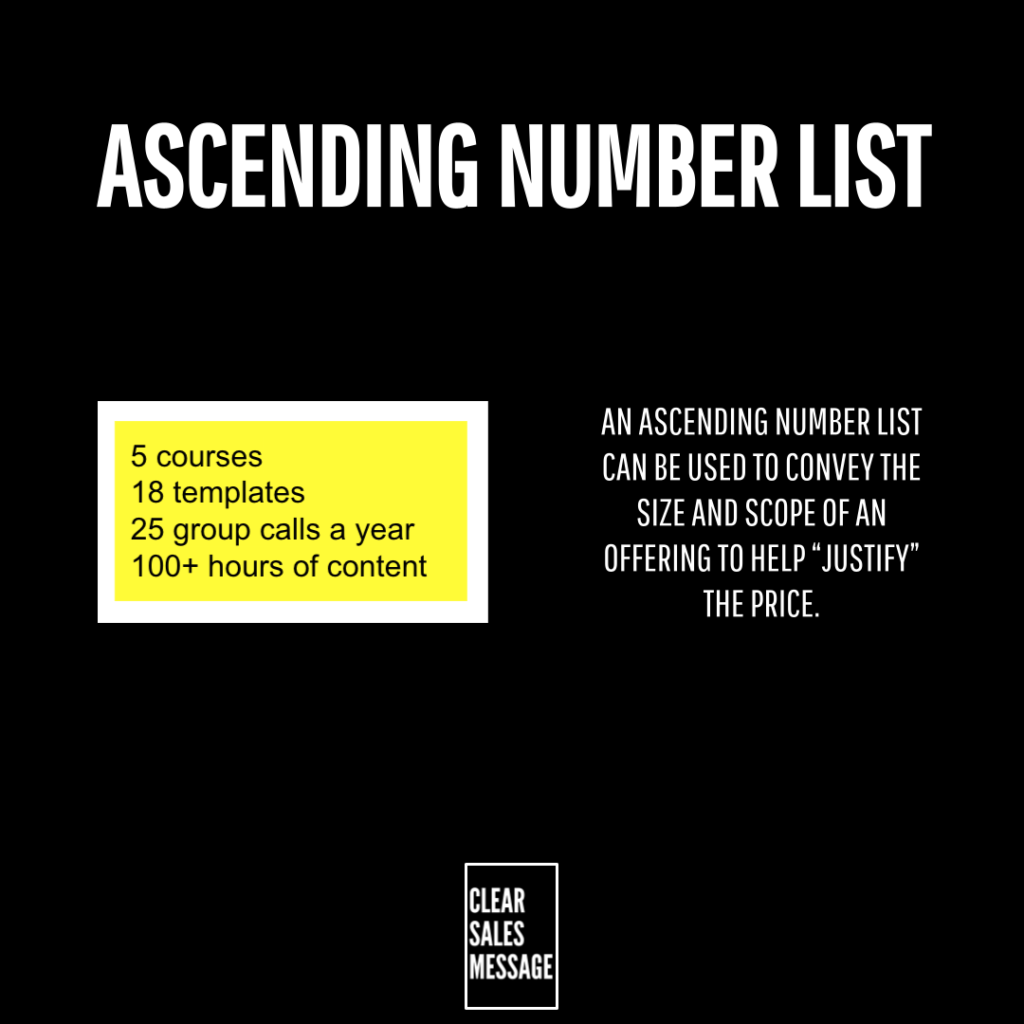
Buyers do not always read what you write. But they do notice numbers. And when those numbers keep getting bigger, something shifts in their mind.
An ascending number list uses that reaction deliberately. Instead of listing your deliverables in any order, you sequence them so the numbers climb. The effect is simple but powerful – the offer feels like it is growing as the buyer reads it.
As a result, justifying the price becomes easier. Not because you have added anything, but because the structure of how you present what you already offer makes the scope feel larger and more substantial.
What Is An Ascending Number List?
An ascending number list is a way of presenting your offer where each item in the list carries a larger number than the one before it. The content stays the same – but the order changes to create a sense of growing scale.
For example, instead of listing “50 posts, 3 platforms, £100,000 ad spend” in a random order, you reorder them: 3 platforms, 50 posts, £100,000 ad spend. The numbers climb. The reader feels the list building toward something significant.
It works because of the way we process sequences. When numbers go up, we associate that movement with growth, value, and size. So by the time the buyer reaches the final item, they carry the momentum of everything that came before it.
Why Does An Ascending Number List Work?
When buyers try to justify a price, they look for evidence that the value matches the cost. A long list of deliverables helps – but the order of that list matters more than most people realise.
Starting small and building upward creates a psychological sense of abundance. Each line feels like the offer is getting bigger. By the final number – which is always the largest – the buyer has already processed several steps of growing value. So the closing figure lands in a context that makes it feel earned rather than expensive.
It also works because large numbers at the end of a list benefit from what came before them. A £100,000 figure feels more impressive after a buyer has read through three or four smaller items than if it appears on its own. The build-up does the justification work for you.
Similarly, the structure draws the eye naturally downward. Buyers who skim still pick up the numbers – and a sequence that climbs registers as substantial even on a quick read.
How Can You Use An Ascending Number List In Sales?
Step 1: Gather your numbers
Start by pulling together three types of numbers. First, the scope of your offering – how many things you cover, how many areas you touch. Second, your deliverables – the specific outputs the buyer receives. Third, your activity numbers – the volume of work that goes into delivering the result.
Step 2: Choose the biggest version of each number
Always find the largest honest expression of each figure. For example, if you sell 2,000 units a year but those units are worth £60M, use £60M. The bigger number is still accurate – it is just more impactful. So go through your list and ask: is there a larger but equally true way to express this?
Step 3: Order from smallest to largest
Once you have your numbers, sort them in ascending order. The smallest figure goes first. The largest goes last. That sequence is what creates the effect – each line feels like a step up, and the final number lands with the full weight of the build behind it.
Step 4: Keep the list short
Three to five items is the sweet spot. A list of 17 deliverables loses impact fast – the buyer stops reading and the numbers blur together. So be selective. Cut anything that does not add to the sense of scale, and keep only the items that pull their weight in the sequence.
When An Ascending Number List Works Best
This technique works best when you have a range of numbers that genuinely differ in size. The bigger the gap between your smallest and largest figure, the more powerful the effect. So it suits offers with a mix of small operational details and large commercial outcomes.
It also works well in proposals, pricing pages, and sales decks – anywhere a buyer is actively weighing up whether the cost is justified. Because the list builds toward the largest number, it primes the buyer to see the final figure in context rather than in isolation.
Similarly, it suits verbal pitches. Listing your offer out loud in ascending order gives the conversation a natural rhythm. Each number lands, pauses, and then the next one tops it. That rhythm holds attention and makes the offer feel considered rather than rushed.
When An Ascending Number List Becomes Dangerous
The technique only works if the numbers are real. Inflating figures to make the list look more impressive destroys trust the moment a buyer checks. So every number on the list needs to be accurate and defensible.
It can also backfire if the final number is not actually that large. If your biggest figure is only marginally bigger than your smallest, the build falls flat. The ascending effect needs genuine contrast to land – otherwise the sequence just looks like a randomly ordered list.
Finally, do not use it to pad out a weak offer. If the underlying value is not there, a clever list structure will not save it. Buyers notice when the numbers look big but the actual benefit is small.
Common Ascending Number List Mistakes
Making the list too long
More items does not mean more impact. Beyond five lines, the ascending effect weakens because the buyer loses track of where the sequence started. Keep it tight – three or four strong numbers beat a sprawling list every time.
Using the same unit throughout
If every item on your list is in the same unit – all hours, all pounds, all items – the variation feels smaller than it is. Mix your units where you can. A list that moves from “3 platforms” to “50 posts” to “£100,000 managed” feels more varied and substantial than one that stays in a single dimension.
Burying the largest number in the middle
The final position is the most powerful. That is where the buyer’s attention peaks and where the number lands hardest. So always save the biggest figure for last – putting it in the middle wastes the build and breaks the effect.
Not using the biggest honest version of each number
Many salespeople undersell by defaulting to the smallest accurate number. But if £60M is just as true as 2,000 units, use £60M. Go through every item and ask whether you are using the most impactful honest figure – because that choice alone can transform how the list lands.
Ascending Number List – An Example
A digital marketing agency wants to show the value of its social media management package. Instead of listing deliverables in a random order, they sequence them as an ascending number list:
“With our monthly plan, you get:
- 3 social media platforms fully managed.
- 30 posts written and scheduled.
- 50,000 impressions guaranteed.
- £100,000 in ad spend optimised for maximum ROI.”
The numbers climb from 3 to £100,000. Each line tops the one before it. By the time the buyer reaches the final figure, they have already processed three steps of growing value – so the cost feels proportionate rather than steep.
Compare that to the same list in a random order: “30 posts, £100,000 ad spend, 3 platforms, 50,000 impressions.” The information is identical, but the effect is completely flat. Order is everything.
See Also
- Descending Number List
- Big Number Effect
- Small Number Effect
- 150+ ways to connect with your buyer
- 140+ ways to be easier to buy from