

Practical Sales Training™ > How To Keep Your Clients Happy > The Aftercare Effect
The Aftercare Effect
Most businesses focus on the sale. Few think carefully about what happens after. But for a buyer, the experience after the purchase often shapes how they feel about you long term.
When something goes wrong or a buyer needs help, the path of least resistance matters. If they have to call, wait, explain, and wait again, the experience costs them time and patience. But finding the answer in two minutes makes their life easier without you lifting a finger.
The Aftercare Effect is about giving clients the resources they need to get the best from your offer. It also means helping them fix problems without having to contact you.
What Is The Aftercare Effect?
Most buyers do not want to call you. They want to get on with using what they bought. When you make it easy to do that, they feel looked after. Because the help is there when they need it, they do not notice the effort you put in. They just notice that things work.
It also signals that you thought about them beyond the sale. Most businesses stop talking once the money changes hands. A business with proper aftercare sends a clear message: we care about your experience, not just your purchase.
There is a self-service angle too. A buyer who can solve their own problem feels capable rather than stuck. That is a better feeling than waiting on hold. And when you give buyers the tools to help themselves, your support load drops at the same time.
Why Does The Aftercare Effect Work?
Buyers form their view of your business from every interaction, not just the sale. The moment they hit a problem and cannot find help is the moment their opinion starts to drop. The Aftercare Effect prevents that by ensuring the experience stays smooth from day one to day one hundred.
It also demonstrates that you understand your clients’ needs. Most products and services have common sticking points. When you have anticipated those and answered them in advance, you show that you know your buyers well. That kind of care builds trust.
There is also a loyalty effect. A client who knows they can always find help when they need it has less reason to look elsewhere. Because switching to a new supplier means starting from scratch with an unfamiliar product, smooth aftercare is one of the strongest reasons to stay.
How Can You Use The Aftercare Effect?
Think about every way a client might need help with your offering. Getting started. Fixing a common issue. Replacing something that wears out. Connecting with others who use it. Each of those needs is a gap you can fill before they feel it.
Depending on your offering, there are several elements you can use to take better care of your existing clients:
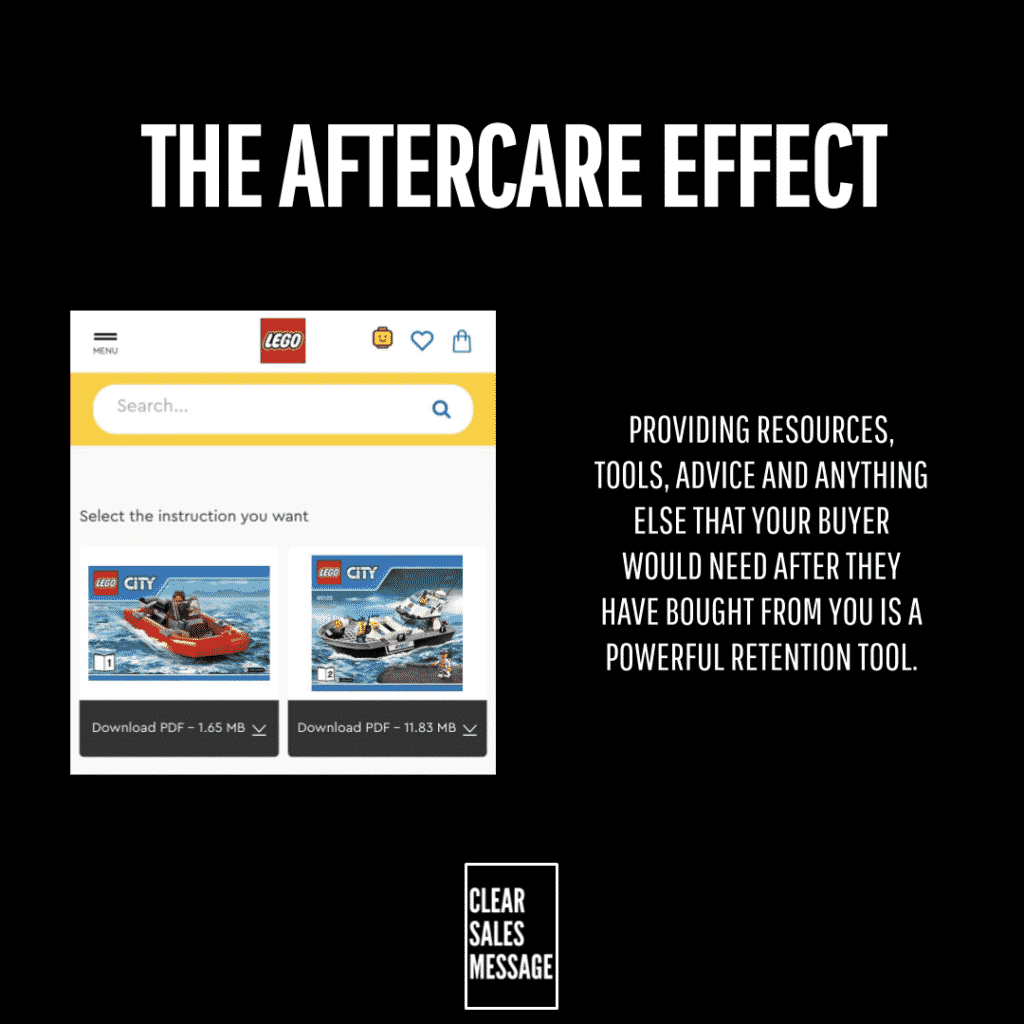
- Paperwork, guides, and manuals – Access to important documents, just as LEGO provide instructions and part lists for every set they have ever made.
- Forum – Access to other users so they can share experiences and ask questions.
- Spare parts – The ability to buy a new part rather than replace the whole product.
- FAQ – Answers to common questions so buyers do not need to reach out to you.
- Troubleshooting – Access to common issues and guides on how to resolve them.
- Tutorials – Step-by-step guides on how to get the most from your offering.
- Useful links – A single page linking to all of the above.
Make the resources easy to find. A dedicated help section on your website, a link in every confirmation email, a follow-up message after purchase. Because the buyer needs help when they hit a problem, the resource has to be there at that moment.
When The Aftercare Effect Works Best
The Aftercare Effect works best when your offer has a learning curve or involves parts that break. Physical products, software, services with an onboarding phase. In all of those, buyers will hit friction points. The question is whether you have answered those points in advance or left them to figure it out alone.
It also works well for businesses building long-term client bonds. When a client knows they can always find help without a call or a wait, loyalty builds. Because the experience of using your offering stays smooth, they have no reason to look elsewhere.
It is also valuable when buyers are less experienced with your type of product or service. A new user who hits a problem early is at risk of giving up. Good aftercare catches that moment and keeps them moving forward. That saves a sale you had already made.
When The Aftercare Effect Becomes Dangerous
The main risk is letting your aftercare resources go out of date. A guide that refers to an old version of your product can create more confusion than it resolves. Set a reminder to review and update your content whenever the product or service changes.
There is also a risk of building too much without any structure. A help section with fifty unorganised pages is harder to use than a clean FAQ with ten clear answers. Keep it focused. A small set of well-organised resources beats a large library that no one can navigate.
Common Aftercare Effect Mistakes
Waiting for Complaints Before Acting
The most common mistake is waiting until buyers complain before creating aftercare content. At that point you are reacting, not leading. Instead, look at your most common support queries right now and turn the answers into self-service content. That is the fastest way to build something useful.
Hiding the Resources
A second mistake is hiding the resources. Burying a brilliant FAQ three clicks deep in a footer might as well not exist. Put a link to your help section in your welcome email and your order confirmation. Make it hard to miss.
Building It Once and Leaving It
Aftercare resources need maintenance. As your product or service changes, so do the questions buyers ask. Review your help content regularly and add new answers as new patterns emerge. An outdated help section is worse than none because it sends buyers in the wrong direction.
The Aftercare Effect – An Example
Apple builds one of the most complete aftercare systems there is. After buying an iPhone, every user has access to a detailed guide online. There is also a troubleshooting page, video tutorials, FAQs, and a forum where users help each other. Users can order spare parts or book repairs online without calling anyone. Because every buyer lands somewhere useful when things go wrong, the ownership experience stays positive long after the sale.
That is what good aftercare does. It keeps the experience smooth. And when the experience stays smooth, buyers stay.
See Also