
Practical Sales Training™ > How To Convert > Pay Now Start Later

Pay Now Start Later
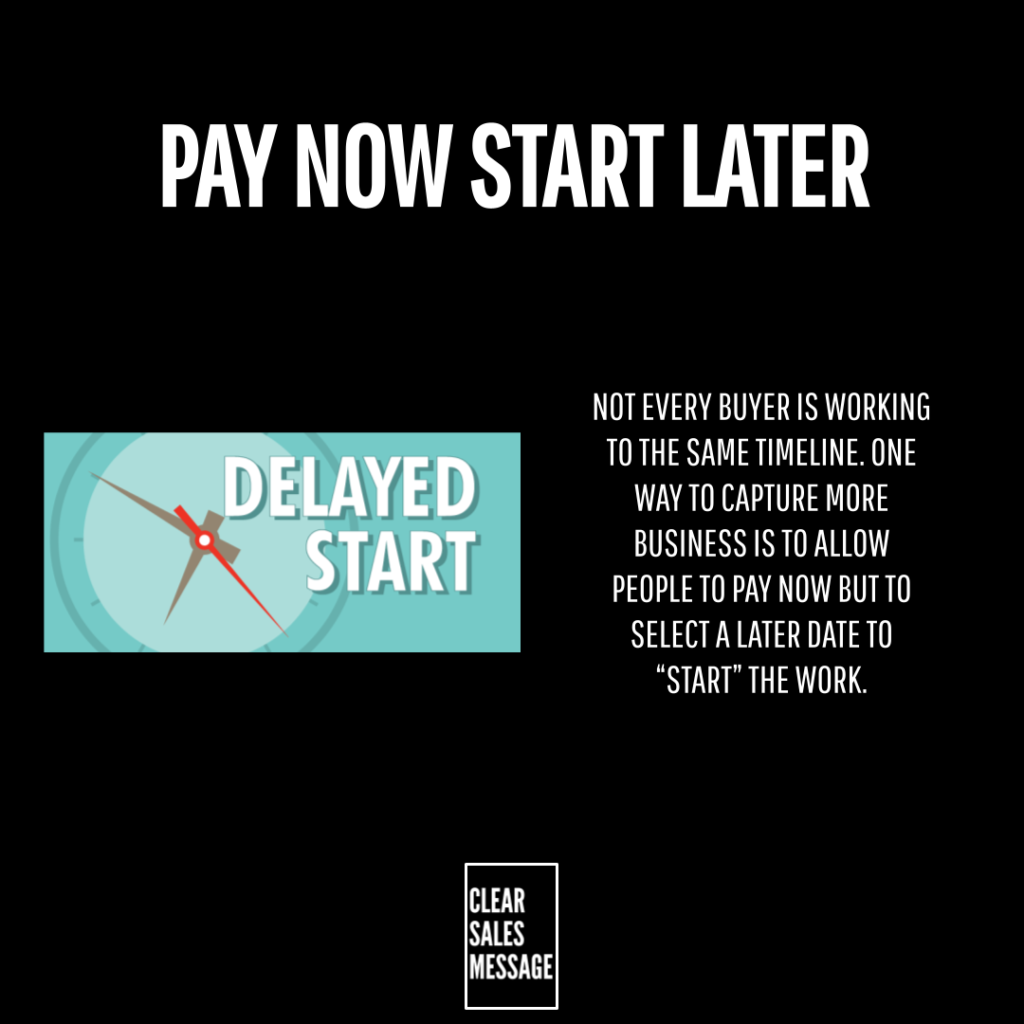
Not every buyer is ready to start right now. Their schedule might be busy, their team not quite ready, or a better moment just around the corner. But many of those buyers are ready to commit, and even happy to pay, if you let them choose when things begin.
Pay Now Start Later captures that business. Instead of losing a buyer to “maybe later,” you give them a way to lock in the deal today and start when the timing suits them. The revenue lands now, the delivery happens when they are ready, and you never had to push them into anything.
As a mechanism, it is simple. But it removes one of the most common reasons buyers delay.
What Is Pay Now Start Later?
Pay Now Start Later is a payment structure that lets buyers secure a product, service, or place by paying upfront. They then choose when to actually begin. The payment, whether a full amount or a deposit, confirms the commitment while the start date stays flexible.
The approach works well when buyers face a time-sensitive offer, such as a set price or limited availability, but cannot commit to an immediate start. By splitting the payment decision from the timing decision, you remove the friction that would otherwise cause them to walk away.
Why Does Pay Now Start Later Work?
The model works because it gives buyers control. Most buyers do not object to your product or your price. They object to starting right now. So when you remove that pressure and let them choose the timing, the objection disappears and the sale becomes much easier to close.
There is also a fear of missing out element at play. A buyer who knows a price is about to rise will pay now to hold their spot. Even if they cannot start immediately, the flexible start date makes that choice feel comfortable rather than forced.
From a business point of view, the model locks in revenue and future work at the same time. You collect money today and book a future slot. And you never need to pressure the buyer into a date that does not suit them.
How Can You Use Pay Now Start Later In Sales?
Decide Whether to Take a Deposit or Full Payment
The first decision is how much to take upfront. A full payment locks in maximum revenue and shows strong buyer commitment. A deposit, however, lowers the barrier to saying yes and suits buyers who are not yet ready to commit fully. Consider what makes sense for your offer and your typical buyer. Then set the terms clearly so there is no confusion later.
Set a Clear Window for When They Must Start
Flexibility needs limits. Give buyers a generous window, such as three or six months, but be clear about the deadline. Without a limit, some buyers will delay with no end in sight. That blocks availability for new clients and makes planning difficult. A defined window feels fair to the buyer while protecting your ability to deliver.
Use It to Protect Promotional Pricing
Pay Now Start Later works especially well when you run a time-limited offer. Buyers who want the set price but cannot start immediately have a clear reason to pay now. As a result, you capture commitment at the moment interest is highest. You do not lose the buyer to delay after the offer ends.
When Pay Now Start Later Works Best
The model works best when your offer involves a set delivery slot, a limited number of places, or a price that may rise. In those cases, the buyer has a real reason to act now even if they cannot start now. That mix of urgency and flexibility is what makes this approach so effective.
Service businesses benefit well from this structure. Coaches, consultants, trainers, and anyone who works on a session or project basis can use it to fill their future schedule. Because the buyer controls the timing, there is no pressure and no awkward push to commit to a date they are not ready for.
Where Pay Now Start Later Becomes Difficult
The model is harder to manage when your delivery cost is high regardless of when the buyer starts. If you need to hold staff or materials in reserve for a flexible start, the benefit of early payment may be offset by the cost of managing open-ended bookings.
There is also a risk of buyers delaying so long that delivery becomes awkward or impossible. So set your window carefully. Include a clear policy for what happens if the buyer does not start within it. Clarity upfront prevents disputes later and protects both sides.
Common Pay Now Start Later Mistakes
No Expiry on the Flexibility
Open-ended flexibility with no deadline creates a pipeline you cannot plan around. Some buyers will hold their booking with no sign of moving forward. That blocks space for new clients and makes it hard to forecast. Always attach a firm but fair deadline to any Pay Now Start Later arrangement.
Not Being Clear About What the Payment Secures
Buyers need to understand exactly what they are paying for and what they are locking in. Is it a specific price? A specific package? A place in a cohort? Confusion at the payment stage creates problems at the delivery stage. So spell it out clearly before the buyer commits.
Using It as a Pressure Tactic Rather Than a Genuine Benefit
Pay Now Start Later works because it genuinely helps the buyer. Using it purely to rush payment from someone who is not ready will damage trust when the reality does not match the promise. Only offer this model when the flexibility is real and the terms are ones you can honour.
Pay Now Start Later – An Example
A photography studio offers a “Book Now, Shoot Later” package for family portraits. Clients pay £200 upfront to lock in the current set price. They then have six months to pick a date for their shoot.
The model appeals to clients who want to secure the deal before a price rise or a busy season. But they are not yet ready to commit to a specific date. For the studio, it brings in cash now and fills the future diary without chasing anyone into a slot that does not work for them. Both sides get what they want, and the sale closes before timing ever becomes a reason to walk away.
6 Different Ways to Structure Payment for Your Offering
- Pay now start later – Allow buyers to secure something but not take delivery or use it until later when they are ready.
- Pay on results – Take payment when you have delivered the desired result for your buyer.
- Pay as you go – Buyers pay as they consume your offering, with no upfront commitment.
- Prepayment – Buyers create a credit balance that they can then draw down over time.
- Buy now pay later – Let buyers take the product today but settle the payment later.
- Finance – Offer finance and instalment payments to ease cashflow for your buyer.